
Female Androgenetic Alopecia: Understanding Pattern Hair Loss in Females
When most people picture pattern hair loss, they picture a receding male hairline. But female androgenetic alopecia is one of the most common forms of hair loss in women, affecting an estimated one in three women at some point in their lives, and its rate rises sharply after menopause. Because it looks and behaves differently than the male version of the condition, it is also widely misunderstood, misdiagnosed, and undertreated. Understanding what is actually happening at the follicular level is the key to catching it early and choosing a treatment plan that works.
What is Female Androgenetic Alopecia?
Female androgenetic alopecia, also called female pattern hair loss, is a genetic, hormone-influenced condition in which scalp hair follicles gradually shrink, or miniaturize, over successive growth cycles. Each miniaturized follicle produces a finer, shorter, less pigmented hair than the one before it, until the follicle eventually produces only a fine vellus hair or stops growing altogether. Unlike male pattern baldness, Female androgenetic alopecia rarely leads to complete baldness; instead, it produces a widespread thinning of hair density across the scalp.
The condition is driven by a combination of genetic predisposition and androgen sensitivity, though the exact hormonal picture in women is more complex than in men. Follicles that are genetically sensitive to circulating androgens, including dihydrotestosterone (DHT), respond by shortening their active growth phase (anagen) and lengthening the time they spend dormant, which is what produces the gradual thinning seen in women.
How This Pattern Differs From Male hair Loss
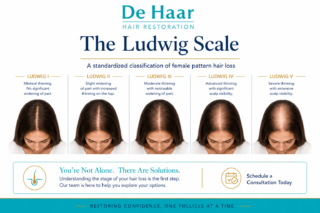
In men, androgenetic alopecia typically produces a receding hairline and a bald crown, following a well-mapped progression known as the Norwood scale. In women, the pattern is different, and dermatologists classify it using the Ludwig scale instead. Female androgenetic alopecia usually presents as diffuse thinning across the crown and the top of the scalp, with a widening part line, while the frontal hairline is generally preserved. In more advanced cases, this can progress to a “Christmas tree” pattern, where thinning is most pronounced just behind the hairline and fans out toward the crown. Some women also experience a related but distinct condition called frontal fibrosing alopecia, which does affect the hairline and requires a different diagnostic approach. This difference in pattern is thought to relate to variation in androgen receptor distribution across the female scalp, along with the protective role that estrogen plays in the hair cycle. Because estrogen levels drop sharply during perimenopause and menopause, many women notice their first significant thinning during this transition, even though the underlying genetic sensitivity may have been present for years.
What Causes Female Androgenetic Alopecia
Like the male form of the condition, Female alopecia is polygenic, meaning it results from the combined effect of multiple genes rather than a single inherited trait, and it can be passed down from either side of the family. A woman with a strong family history of hair thinning, on either her mother’s or father’s side, has a meaningfully higher likelihood of developing the condition herself.
Hormonal shifts are a major factor in when and how visibly the condition appears. Pregnancy, menopause, polycystic ovary syndrome (PCOS), and certain hormonal medications can all influence androgen activity or estrogen levels enough to accelerate visible thinning. This is part of why female androgenetic alopecia often seems to “appear” during a specific life stage rather than progressing at a steady, predictable rate the way it more commonly does in men.
Aging itself also plays a role independent of hormones, since hair density and follicle size naturally decline over time. This is one reason an accurate diagnosis matters: age-related thinning, hormonal thinning, and other causes of hair loss can overlap and need to be untangled by a qualified provider.
Ruling Out Other Causes
Because diffuse thinning can result from several different underlying processes, a proper evaluation is essential before starting treatment. Conditions that can mimic or coexist with female androgenetic alopecia include telogen effluvium (temporary, stress- or illness-triggered shedding), thyroid dysfunction, iron deficiency, and, less commonly, autoimmune conditions such as alopecia areata.
A hair loss specialist will typically take a detailed history, examine the scalp and hair shafts under magnification (trichoscopy), and may order bloodwork, including thyroid function and ferritin levels, to rule out reversible contributors. In some cases, a scalp biopsy may be used to confirm the diagnosis or rule out a scarring alopecia, which requires a different treatment approach entirely. Getting this diagnosis right is what determines whether the correct next step is medical therapy, further workup for an underlying condition, or, for more advanced or stable cases, surgical restoration.
Treatment Options for Female Androgenetic Alopecia
Female Androgenetic Alopecia is a progressive condition, so the earlier it is identified and treated, the more existing hair density can typically be preserved.
Topical and Oral medications may be effective for female pattern hair loss but this depends on the diagnosis. There are many other medications that may be effective in your particular case. . Read how medications for hair loss work here.
Anti-androgen therapies, such as spironolactone, finasteride and other oral medications are sometimes prescribed off-label to reduce androgen activity, particularly in women with evidence of hormonal imbalance such as PCOS. Some of theses medications require a physician’s evaluation, since they are not appropriate for everyone as certain medications should be avoided by women who wish or may become pregnant as they may cause birth defects.
Platelet-rich plasma (PRP) and microneedling use a patient’s own growth factors or controlled micro-injury to stimulate the scalp’s regenerative signaling pathways, and are increasingly used alongside other therapies to support follicle health.
Microneedling with Exosomes/Peptides and other biologics deliver active ingredients to the follicular level to help facilitate regeneration of the weakened and damaged follicles .Read more about microneedling
Low-level laser therapy (LLLT) is a supportive, non-invasive option thought to stimulate cellular activity in the follicle and encourage a shift toward active growth.
Hair transplantation can work in certain cases redistributing hair to areas where a visual impact may be needed.
When Hair Transplantation Becomes an Option
For women whose thinning has progressed to the point where medical therapy alone is unlikely to restore meaningful density, hair transplantation is increasingly used and can be highly effective, provided candidacy is assessed correctly. Because female Hair Loss typically presents as diffuse thinning rather than complete follicle loss in a defined area, transplant planning in women requires a careful evaluation of donor supply and ongoing miniaturization elsewhere on the scalp, so that results remain natural and stable over time.
As with male pattern hair loss, transplanted follicles are typically taken from areas of the scalp that are genetically resistant to androgen-driven miniaturization, allowing them to continue growing permanently once relocated. Combining a transplant with topical minoxidil or other medical therapy afterward can help protect the surrounding native hair and support long-term results.
In Conclusion
Female androgenetic alopecia is common, progressive, and driven by a genuine biological process, not a personal failing or something to simply “manage” quietly. Because it can look similar to several other causes of hair thinning, an accurate diagnosis from a qualified provider is the essential first step. From there, women have more effective, evidence-based options today than ever before, ranging from topical and hormonal therapies to advanced restoration techniques, to slow, stabilize, or reverse the appearance of thinning hair. We are highly experienced at successfully treating Female Androgenetic Alopecia. Our entire team is here for you and we can help.
Read about PCOS and hair loss in women and The Thyroid Connection to Hair Loss.
