
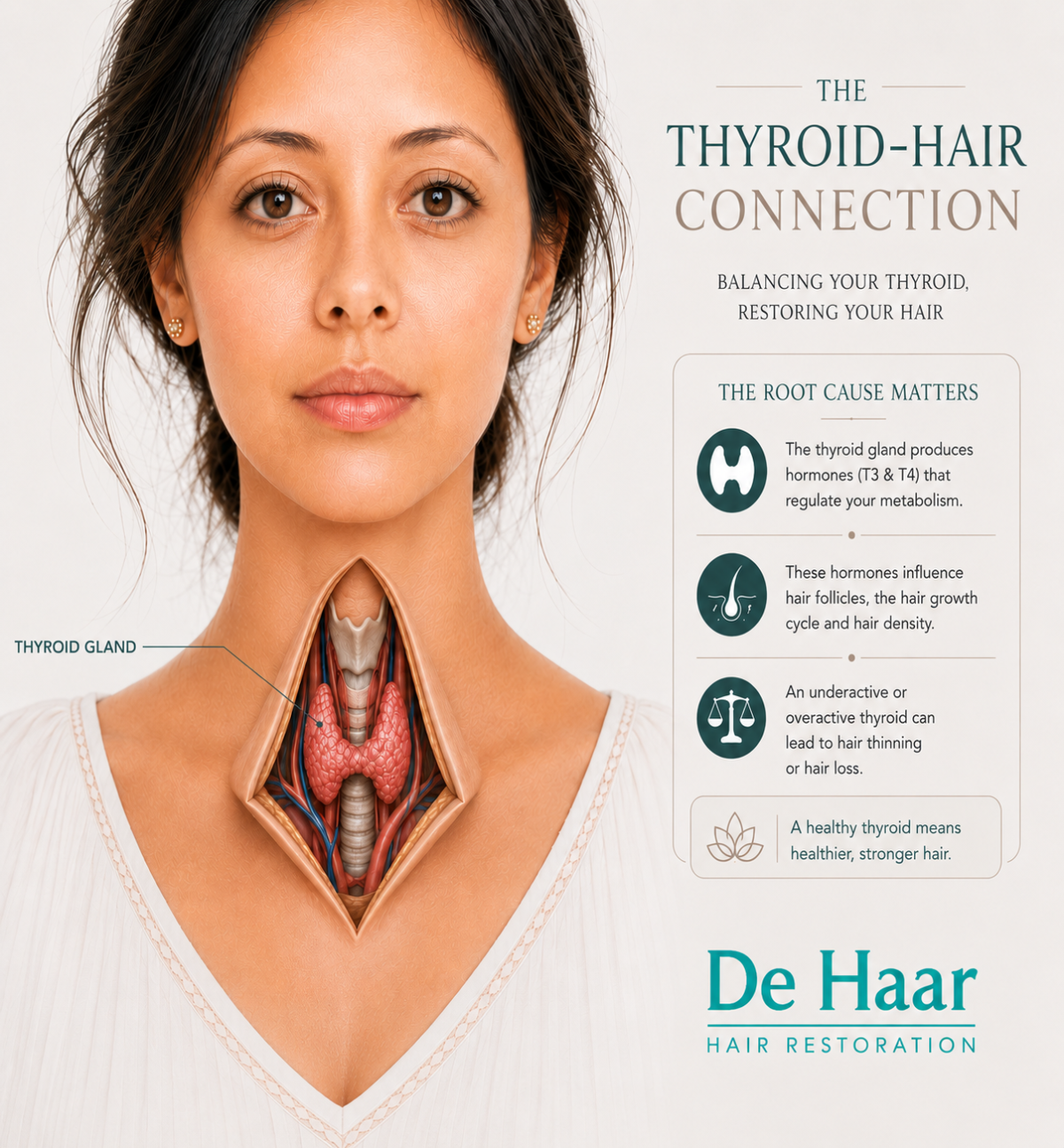
The thyroid gland plays a critical role in regulating the health and function of your hair follicles. Even subtle changes in thyroid hormone levels can have a significant impact on the scalp and hair. Understanding this relationship is essential for accurate diagnosis and effective treatment of thyroid related hair loss.
Thyroid hormones support hair follicle health
The thyroid gland produces 2 primary hormones, T3 (Triiodothyronine) and T4 (Thyroxine) , which are the two main hormones produced by the thyroid that control the body’s metabolic rate, energy production, and cellular turnover. T3 is the most powerful and active of the two. It plays a major role in controlling how fast your body burns energy, regulates the heart rate, supports brain function, influences hair and nails, affects digestion and controls body temperature. T3 helps maintain scalp health by regulating blood vessel dilation, sebaceous glands, oxygen and nutrient delivery to the hair follicles. T4’s primary role is to be converted to T3. T4 acts as a hormone reserve and gets converted when the body demands heat, energy or metabolic activity. The thyroid gland produces T4 in response to TSH from the pituitary gland. T4 is converted in organs such as the liver and kidneys.
Thyroid hormone imbalance interrupts the hair growth cycle
Hair follicles are among the most metabolically active structures in the body and heavily rely on T3 and T4 to sustain healthy hair growth. These hormones support the antigen (growth) phase, keratinocyte proliferation, stem cell activity and the microcirculation that transports nutrients and blood to the hair follicle. When thyroid hormone levels become imbalanced, the follicle prematurely shifts into the telogen (shedding) phase, resulting in diffuse thinning and increased hair loss.
Hypothyroidism, which is an underactive thyroid, slows down metabolic processes throughout the body. This reduction in cellular turnover has a direct impact on the scalp. Common hair related manifestations due to hypothyroidism include diffuse thinning across the entire scalp, dry coarse brittle hair, reduced hair diameter, slower overall hair growth, and thinning of the lateral eyebrows, which is a classic sign. This condition typically produces a form of telogen effluvium, which is where a higher than normal percentage of follicles remain in the telogen phase and shed simultaneously. In many patients, low T3 levels cause diffuse thinning on the crown, top and sides of the scalp which often appears similar to androgenetic alopecia but the cause here is metabolic driven and not genetically driven. Often with blood testing the TSH can appear normal but the free T3 is low.
Hyperthyroidism, which is an overactive thyroid, accelerates metabolic processes and places the body into a heightened state of physiological stress. This rapid turnover destabilizes the normal growth cycle of the hair. Hair changes that are seen in hyperthyroidism include accelerated thinning, fine and soft yet fragile hair, increased shedding and a shortened antigen or growth phase leading to reduced density. Although the presentation differs slightly from hypothyroidism, the mechanisms again results in telogen effluvium.
Autoimmune disorders such as Hashimoto’s thyroiditis and Graves’ disease are major causes of thyroid dysfunction. In some individuals, autoimmune activity extends to the hair follicles themselves. This can result in alopecia areata, characterized by sudden circular bald patches, loss of scalp and outer eyebrow hair, and in males, can include beard hair. Occasionally, in severe cases it can cause total scalp or body hair loss. Alopecia areata is an immune mediated condition and must be managed differently from hormonally driven conditions. Initiating and adjusting thyroid medications can temporarily increase shedding as the follicles recalibrate. This reaction is typical and resolves once hormone levels stabilize. Most patients notice an improvement within 6 to 12 weeks of receiving thyroid treatment.
Thyroid dysfunction and coexisting factors should be addressed simultaneously
Thyroid dysfunction often coexists with micronutrient deficiencies that further disrupt healthy hair growth. The most common deficiencies include Ferritin, B12, vitamin D, Zinc, impaired protein absorption and metabolism. Correcting the thyroid hormonal balance alone may not fully restore your hair unless these systemic factors are evaluated and treated. In most cases, hair loss caused by thyroid disease is reversible. Once hormone levels are optimized, the follicles will gradually return to a normal growth cycle. However, this regrowth typically begins within three to four months of starting thyroid treatment and correcting the deficiencies. A noticeable increase in density will be seen at 6 to 12 months. Long term, untreated thyroid disease may cause incomplete recovery. Coexisting factors such as certain medications, heavy metal toxicity and androgenetic alopecia may mask regrowth unless addressed simultaneously. Early diagnosis and comprehensive treatment offer the best outcomes.
When to seek professional help
One should consider thyroid testing if they experience sudden, diffuse hair shedding, changes in hair texture or quality, eyebrow thinning especially in the lateral region of the eyebrow, fatigue and weight changes, skin dryness, sensitivity to cold and heat, irregular heart rate, and any neck swelling or discomfort.
Your doctor or hair loss specialist may order a panel of tests that include a TSH, free T3, reverse T3, free T4 as well as (TPO) Thyroid peroxidase antibodies and (TGAb) Thyroglobulin antibodies to provide a complete picture of your thyroid function.
In Conclusion
The thyroid gland and the hair follicles share an intricate metabolic and hormonal relationship. Imbalances in thyroid function, whether due to hypothyroidism, hyperthyroidism, autoimmune disease or medication changes can disrupt the hair growth cycle and lead to increased shedding, thinning, and changes in hair texture. With proper diagnosis, medical management, and supportive treatment, most individuals can expect significant improvement and, in many cases, a full recovery of their hair density.
One comment
Pingback: Hair Loss Diagnosis: Your Complete Guide to Understanding the Cause Before Choosing Treatment – De Haar Hair Restoration
Comments are closed.