
Does Microneedling Actually Restore Hair and How Does It Work?
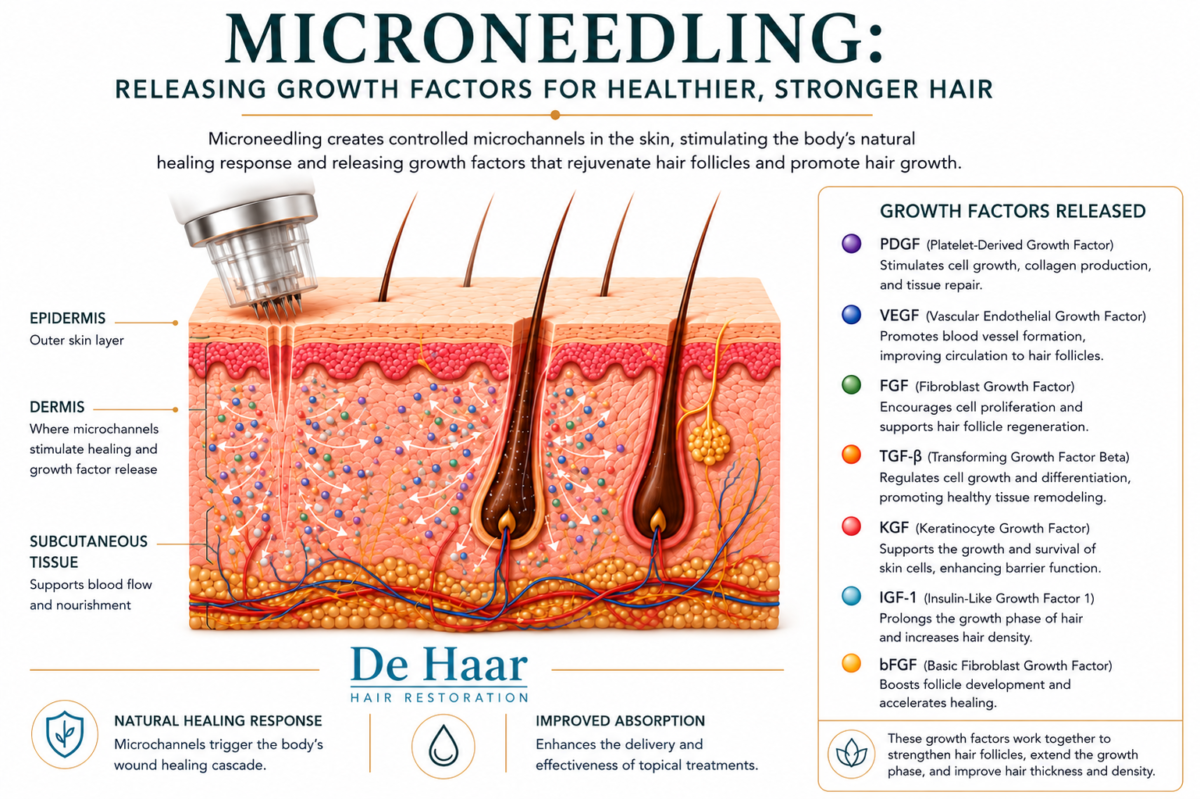
In recent years, one therapy has gained remarkable attention for its simplicity, safety and scientific grounding. Microneedling! Originally developed for skin rejuvenation, microneedling has become a powerful technique for stimulating natural hair regrowth. Its success is supported by clinical research, dermatological science, and countless patient results around the world. Microneedling involves using a specialized device that contains fine sterile needles. These needles create controlled micro injuries at specific depths in the scalp. This process may sound counterintuitive, but the body’s natural healing response is what makes this treatment so effective.
How does it work?
When the scalp is micro needled, the body immediately activates a cascade of wound healing mechanisms. These include the release of growth factors, cytokines, and stem cell signals that repair tissue and stimulate new cell formation. Among the key biological responses is platelet activation. The micro channels cause micro injuries that trigger your platelets to release powerful growth factors such as; platelet derived growth factor, vascular endothelial growth factor, epidermal growth factor, and transforming growth factor. Collagen remodeling also occurs because fibroblasts are activated to produce collagen and elastin, improving your scalp health and skin structure. Revascularization occurs meaning new blood vessels are created which increase oxygen and nutrient delivery to damaged or miniaturized hair follicles. The response to the microneedle injury also stimulates the stem cells in the hair follicle which is crucial for initiating new hair growth cycles.
The result is a rejuvenated microenvironment in the scalp that promotes thicker, stronger, and more resilient hair growth. Hair follicles undergo natural phases of growth, the anagen (growth), catagen(resting) and telogen(shedding) phases which occur in all individuals experiencing androgenetic alopecia and other forms of hair thinning. Many follicles become miniaturized and remains stuck in the resting phase. Microneedling helps to wake up dormant follicles through several synergistic mechanisms. The first is enhanced blood flow and oxygenation. Microneedling increases scalp microcirculation. New capillaries form to deliver essential nutrients, hormones and oxygen directly to the hair follicle root. This is critical because poor blood supply is often a key factor in the loss of or damage to follicles. This improved circulation helps to reenergize follicle metabolism and extend the anagen (growth) phase of the hair cycle. Activation of growth factors also occurs with micro needling. The cascade of growth factors acts as a natural fertilizer for follicles. (VEGF) vascularization endothelial growth factor encourages new blood vessel formation. (EGF) Epidermal growth factor supports keratinocyte proliferation and (IGF) Insulin-like growth factor is a critical protein that promotes collagen and hair shaft elongation. Collectively, these bio products reawaken follicles that have become dormant. Stimulation of stem cells and dermal papilla cells also occurs. The dermal papilla at the base of each follicle contains specialized stem cells responsible for hair regeneration. Microneedling directly stimulates these cells, enhancing their ability to produce new hair.
What do the studies show?
Moreover, studies show that microneedling increases B-catenin expression, a critical signaling molecule in hair follicle development. Numerous clinical studies over the past decade have demonstrated the efficacy of microneedling in promoting hair regrowth, particularly when combined with topical treatments such as minoxidil, platelet rich plasma and growth factor serums. One landmark study, published in the Internal Journal of Trichology in 2013, compared two groups of men with androgenetic alopecia, one treated with minoxidil alone and the other with microneedling plus minoxidil. After 12 weeks, the microneedling group showed four times greater hair count. Other clinical trials have reported similar outcomes, emphasizing that microneedling not only boosts hair density but also improves the penetration and absorption of topical agents. This dual action of biological stimulation and enhanced delivery sets microneedling apart from many other scalp treatments. Another key reason microneedling is effective in hair restoration lies in the collagen remodeling. Over time, the scalps extracellular matrix becomes fibrotic, particularly in areas affected by chronic inflammation. This fibrosis restricts hair follicle growth and compresses the surrounding blood vessels. Microneedling breaks down old fibrotic tissue and stimulates the formation of new collagen fibers. This creates a healthier scalp that supports follicle anchoring and resilience. A stronger, more flexible matrix also improves nutrient diffusion and mechanical support for regenerated follicles.
The combination effect
The effectiveness of microneedling is magnified when combined with bio active substances. The most popular is growth factor formulations contain exosomes and growth factors. The micro channels allow growth factors to penetrate deeply into the follicular unit, producing more robust results. Similarly, when stem cells, serums, exosomes or peptide based growth formulas are used, microneedling serves as the perfect delivery system. The skin’s natural barrier normally limits absorption, but microneedling temporarily opens up micro channels that close within hours, enabling optimal diffusion without the risk of infection.
Microneedling works for both men and women. Microneedling triggers a purely regenerative biological process which works equally well for men and women because it does not depend on androgen modulation. Women in particular who often experience diffuse thinning due to hormonal changes, stress or genetics benefit significantly from microneedling. It improves scalp texture, hair density and supports non hormonal hair regrowth safely without systemic side effects.
Does depth of the microneedles matter and when can I see results?
The effectiveness of microneedling depends on using appropriate needle depths and treatment intervals for hair restoration. Clinical settings typically use needle depths ranging from 0.5 to 1.5mm. Shallower depths target the epidermis for absorption enhancement, while deeper depth penetration stimulates the dermal papilla and follicular stem cells directly. Visible results typically begin around 12 weeks, with continued thickening and density improvement over six months.
Is microneedling safe, does it hurt and are there side effects?
Microneedling is minimally invasive and safe when performed with sterile equipment by trained professionals. A topical anesthetic is applied to the scalp for your comfort and you should feel no pain whatsoever. Side effects are generally mild and temporary, including a mild redness, pinpoint bleeding, or tenderness for 24 to 48 hours post procedure. Because no incisions or heat energy is used, there is virtually no risk of scarring or pigment changes. Patients can return to normal activities within a day, making it one of the most convenient regenerative treatments for hair loss available today.
In Conclusion
While microneedling can deliver significant improvement on its own, it is most often effective as part of a comprehensive restoration strategy. De Haar Hair Restoration regularly integrates microneedling with other evidence based therapies such as (LLLT) low level light therapy, exosomes, peptide infusions, nutritional and hormonal optimization and even surgical hair transplantation. When used post-transplant, microneedling enhances graft survival and accelerates healing by improving blood supply and collagen support in the recipient area. It is extremely effective for patients who have diffuse hair loss where the hair is thinning throughout the scalp. Patients are drawn to microneedling because it is a natural process, chemical free and cost effective. If microneedling, non-surgical hair restoration is something you’re interested in, Talk to us today.
