

Scarring Alopecia; Can I Have a Hair Transplant?
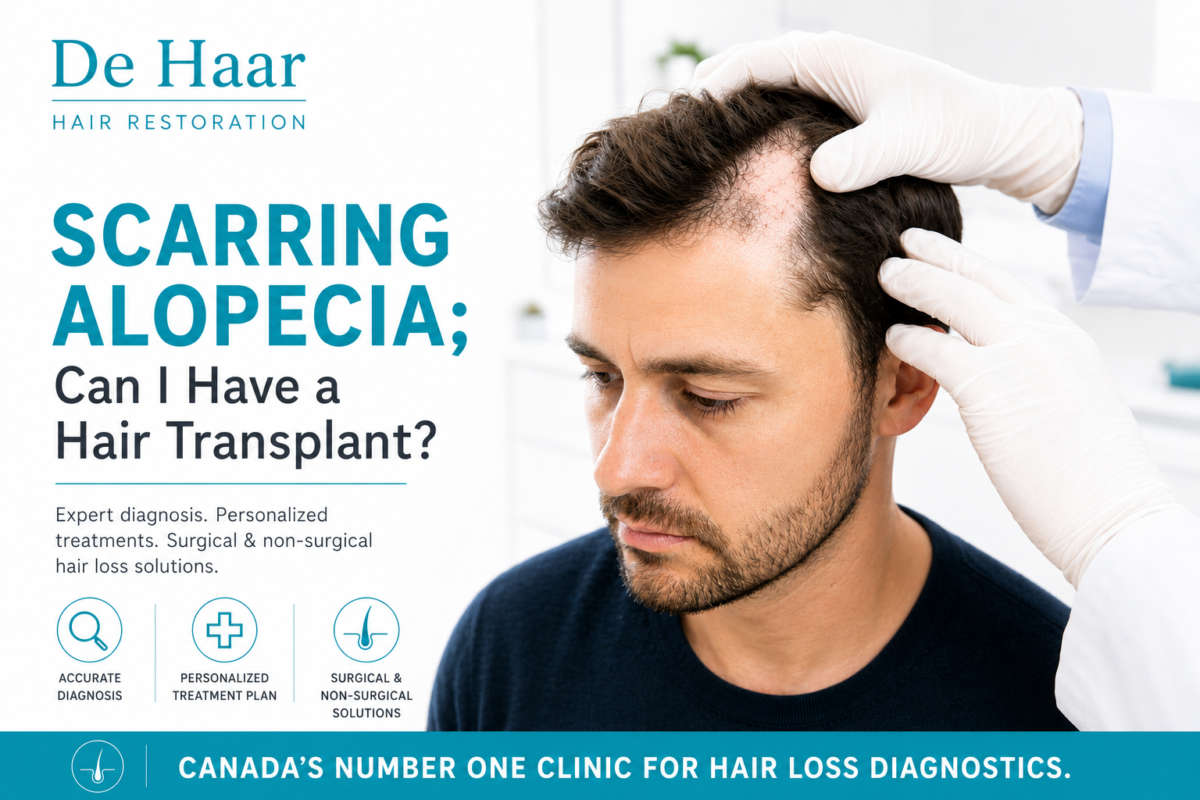
Not all hair loss is created equal, and the distinction matters more than most patients realize. At De Haar Hair Restoration, one of the most important questions we answer during a Trichoscopy consultation is deceptively simple: is this hair loss scarring, or non-scarring? The answer shapes everything that follows, including whether a hair transplant is likely to succeed.
The Core Difference
Hair follicles are living structures. In non-scarring alopecia, the category that includes androgenic (pattern) hair loss, the most common cause of thinning in both men and women, the follicle itself survives, even as it shrinks and produces thinner, shorter hairs over time. Because the follicle is still intact beneath the surface, it generally remains capable of producing hair again, and it’s this category of hair loss that responds well to FUE transplantation.
In scarring (cicatricial) alopecia, the follicle itself is destroyed and replaced with fibrous scar tissue. Once that happens, the follicle cannot regenerate hair on its own, and the scalp in the affected area typically appears smooth, shiny, and free of the small pore-like openings (follicular ostia) where hair would normally emerge. This distinction is the reason a thorough diagnostic workup, not just a visual scan, is essential before any treatment plan is proposed.
Common and Rare Forms of Scarring Alopecia
Several conditions fall under the scarring alopecia umbrella, and they can look similar to one another on the surface, which is why proper diagnosis matters:
- Lichen planopilaris (LPP) is an inflammatory condition that often causes redness, scaling, and itching around affected follicles before scarring sets in.
- Discoid lupus erythematosus (DLE) is an autoimmune condition that can cause scarring patches on the scalp, sometimes alongside skin changes elsewhere on the body.
- Central centrifugal cicatricial alopecia (CCCA) is a slowly progressive scarring pattern that typically begins at the crown.
- Folliculitis decalvans is driven by chronic follicular infection and inflammation.
- Pseudopelade of Brocq is a rare, quiet form of scarring alopecia that often shows little to no visible inflammation, sometimes representing the end stage of one of the conditions above once active inflammation has resolved.
Why this matters for Transplant Candidacy
A hair transplant relocates healthy, living follicles from a donor area to an area of thinning, but it cannot revive a follicle that has already been replaced by scar tissue, and it cannot stop an underlying disease process that is still active. This is why, at De Haar, candidacy always starts with two questions:
- Is the underlying condition currently active, or has it been stable and quiet for a meaningful period of time?
- Is the follicle itself still present, or has it been permanently replaced by scar tissue?
If a scarring condition is still active, transplantation is generally not recommended until it has been medically managed and confirmed stable, since new grafts placed into inflamed tissue are unlikely to survive. Once a scarring alopecia has been confirmed inactive, transplantation can sometimes be considered, though outcomes are typically less predictable than with non-scarring hair loss, since graft survival in scarred tissue tends to be more variable.
How Do We Diagnose It
Every potential hair transplant patient at De Haar begins with Trichoscopy, a magnified scalp examination that lets our team look closely at individual follicles, the surrounding skin, and any signs of inflammation, scaling, or scarring. In cases where a scarring process is suspected, we work alongside dermatology to arrange further evaluation, in some rare a scalp biopsy may be recommended before any surgical plan is discussed. This diagnosis-first approach protects patients from pursuing a procedure that isn’t right for their type of hair loss, and it ensures that if an active inflammatory condition is present, it gets treated on the right timeline.
The Bottom Line
If you’ve noticed smooth, shiny patches of hair loss, or hair loss accompanied by redness, itching, or scaling, it’s worth having it evaluated before assuming a transplant is the answer. The good news is that an accurate diagnosis, whether it points toward pattern hair loss or a scarring condition that needs to be addressed first, gives you a clear and honest path forward. At De Haar, once you’re a patient, we work diligently on your behalf to discover and diagnose the cause of your hair loss, and that means giving you the real picture before recommending any procedure.
