

The first sign of pattern hair loss
Most people don’t notice pattern hair loss the day it begins. It develops so gradually that the changes often go unnoticed for months or even years. A little more of your scalp becomes visible under bright lights. The hairline slowly begins to recede. The part becomes slightly wider. The hair feels thinner. Family members may notice a change before you do, and many people don’t realize how much hair density they’ve lost until they compare recent photographs with those taken several years earlier. Unlike sudden forms of hair loss, androgenetic alopecia is a progressive condition that slowly changes the size and behavior of individual hair follicles over time. The process is so gradual that it often becomes accepted as a normal part of aging, even though it is a distinct medical condition with well-understood causes and a wide range of treatment options. The good news is that androgenetic alopecia is also the most common and one of the most treatable forms of hair loss. Early diagnosis allows many people to preserve existing hair, slow progression, and in appropriate candidates, restore lost hair through medical therapy, non-surgical treatments, or hair transplantation.
In this article, we’ll explain what androgenetic alopecia is, why it occurs, how it affects both men and women, how it is diagnosed, and the treatment options available to help you make informed decisions about your long-term hair health.
What Is Androgenetic Alopecia?
Androgenetic alopecia, more commonly known as male pattern hair loss or female pattern hair loss, is the most common cause of progressive hair thinning in both men and women. It is an inherited condition in which genetically susceptible hair follicles gradually become smaller over time, producing finer, shorter, and less pigmented hairs with each growth cycle. This process, known as follicular miniaturization, eventually reduces overall hair density and, in some cases, may lead to complete loss of visible hair in the affected areas. Unlike sudden forms of hair loss, androgenetic alopecia develops gradually over many years. In men, it typically begins with a receding hairline or thinning at the crown, while women are more likely to notice a widening part or diffuse thinning across the top of the scalp, usually with preservation of the frontal hairline. Although androgenetic alopecia is progressive, it is also one of the most treatable forms of hair loss. Early diagnosis and appropriate treatment can often slow or stabilize further hair loss, preserve existing hair, and, for suitable candidates, restore hair through medical or surgical treatment.
What Causes Androgenetic Alopecia?
Androgenetic alopecia develops as a result of a combination of genetics and hormones. While many people believe hair loss is caused simply by getting older, pattern hair loss is actually a genetically inherited condition in which certain hair follicles become increasingly sensitive to the effects of a naturally occurring hormone called dihydrotestosterone (DHT). DHT is a normal hormone produced from testosterone by an enzyme known as 5-alpha reductase. It plays an important role in normal development and is present in both men and women. However, in individuals who have inherited a genetic sensitivity to DHT, certain hair follicles—particularly those on the top and front of the scalp—gradually begin to respond differently to the hormone. Rather than causing the hair to fall out suddenly, DHT slowly changes the behaviour of susceptible hair follicles through a process called follicular miniaturization. With each new hair growth cycle, the follicles become slightly smaller, producing hairs that are finer, shorter, and lighter in colour. Over many years, this gradual reduction in hair diameter leads to a visible decrease in hair density. Eventually, some follicles may stop producing visible hairs altogether.
Interestingly, not all hair follicles respond to DHT in the same way. Hair follicles located around the back and sides of the scalp, commonly referred to as the donor area, are genetically resistant to the effects of DHT. This natural resistance is one of the reasons why these follicles can often be successfully transplanted to areas affected by pattern hair loss, where they generally continue to grow throughout life. Although DHT plays a central role in androgenetic alopecia, it is important to understand that DHT itself is not the problem. The hormone is present in everyone. What determines whether someone develops male or female pattern hair loss is how genetically sensitive their hair follicles are to its effects. Two people can have similar hormone levels yet experience completely different patterns of hair loss because their follicles respond differently. This is also why androgenetic alopecia progresses at different rates from person to person. Some individuals notice gradual thinning in their twenties, while others retain a full head of hair well into later life. Genetics largely determine when hair loss begins, how quickly it progresses, and the pattern it follows.
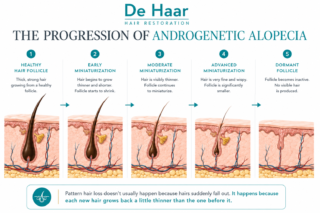
The Progression of Androgenetic Alopecia
Androgenetic alopecia is a gradual process of follicular miniaturization. With each hair growth cycle, genetically susceptible hair follicles produce hairs that become progressively finer, shorter, and less pigmented. Over time, this gradual change reduces overall hair density until some follicles eventually stop producing visible hair altogether.
Who Is at Risk of Developing Androgenetic Alopecia?
Androgenetic alopecia can affect both men and women of all ethnic backgrounds and is the most common cause of progressive hair loss worldwide. Although it is often associated with aging, the condition can begin much earlier in life. Some people notice changes in their late teens or early twenties, while others may not develop visible thinning until much later. The age at which hair loss begins, as well as the rate at which it progresses, is largely influenced by genetics. The greatest risk factor for developing androgenetic alopecia is a family history of pattern hair loss. The condition can be inherited from either side of the family and often affects multiple generations. However, having a family history does not guarantee that an individual will develop noticeable hair loss, nor does the absence of a family history rule it out. The way genes are inherited is complex, and the severity and pattern of hair loss can vary considerably even among close relatives. In men, androgenetic alopecia typically presents as a receding hairline, thinning at the temples, or hair loss at the crown.
Women usually experience a gradual reduction in hair density over the top of the scalp, often noticed as a widening part, while the frontal hairline is generally preserved. Although the patterns differ, the underlying process of follicular miniaturization is the same. Certain medical conditions and hormonal changes may make pattern hair loss more noticeable or accelerate its progression. In women, pregnancy, menopause, or conditions such as polycystic ovary syndrome (PCOS) may contribute to increased thinning in those who are already genetically predisposed. While these factors do not cause androgenetic alopecia on their own, they can influence when the condition becomes apparent. Understanding your individual risk factors is important because early diagnosis provides the greatest opportunity to preserve existing hair. Identifying androgenetic alopecia before significant follicular miniaturization has occurred allows more treatment options to be considered and may improve long-term outcomes.
Signs and Symptoms of Androgenetic Alopecia
Unlike many other forms of hair loss, androgenetic alopecia usually develops gradually rather than suddenly. Because the changes occur over many years, they often go unnoticed in the early stages. Many people first become aware of the condition when they notice more scalp showing in photographs, a widening part, a receding hairline, or a reduction in the overall volume of their hair. One of the earliest signs is a gradual decrease in hair density. Rather than producing thick, healthy hairs, affected follicles begin producing hairs that are finer, shorter, and less pigmented with each growth cycle. As more follicles undergo this process of miniaturization, the scalp becomes increasingly visible, particularly under bright lighting or when the hair is wet. In men, androgenetic alopecia most commonly begins with recession at the temples, creating an “M-shaped” hairline, followed by thinning at the crown. As the condition progresses, these areas may gradually enlarge until they eventually merge, leaving a horseshoe-shaped pattern of hair around the back and sides of the scalp.
In women, the pattern is usually different. Instead of developing a receding hairline, women are more likely to notice diffuse thinning across the top of the scalp and a widening of the natural part. The frontal hairline is often preserved, although overall hair volume gradually decreases, making it more difficult to style the hair or achieve the same fullness as before. One of the distinguishing features of androgenetic alopecia is that the hair loss is typically painless. The scalp usually appears healthy, without redness, scaling, itching, or inflammation. If these symptoms are present, another form of hair loss or an underlying scalp condition should also be considered. Because androgenetic alopecia is progressive, the changes become more noticeable over time if left untreated. Recognizing the early signs and seeking an assessment before significant hair loss has occurred provides the greatest opportunity to preserve existing hair and discuss the treatment options that are most appropriate for your individual needs.
How Is Androgenetic Alopecia Diagnosed?
An accurate diagnosis is the foundation of effective hair restoration. Although androgenetic alopecia has characteristic patterns of hair loss, it should never be assumed that pattern hair loss is the only cause of thinning. Several conditions can produce similar symptoms, making a thorough assessment essential before recommending treatment. The diagnostic process begins with a detailed medical history. Understanding when the hair loss started, how quickly it has progressed, whether there is a family history of pattern hair loss, and whether there have been recent illnesses, medications, hormonal changes, or periods of significant stress helps identify factors that may be contributing to the condition. This information also helps distinguish androgenetic alopecia from other common causes of hair loss, such as telogen effluvium, autoimmune disorders, or nutritional deficiencies. A careful examination of the scalp and hair is equally important. Your clinician will assess the pattern and extent of hair thinning, evaluate the quality and diameter of the hair shafts, examine the donor area at the back and sides of the scalp, and look for any signs of inflammation, scarring, or other scalp conditions. These findings provide valuable information about the stage of hair loss and the overall health of the scalp.
One of the most useful tools in diagnosing androgenetic alopecia is Trichoscopy, a non-invasive examination performed using specialized magnification. Trichoscopy allows clinicians to examine the scalp and hair follicles in much greater detail than is possible with the naked eye. One of the hallmark findings is variation in hair shaft diameter, also known as anisotrichosis, which reflects the process of follicular miniaturization. Trichoscopy may also identify reduced hair density, an increased number of fine vellus hairs, and other features that support the diagnosis while helping to rule out other causes of hair loss. Blood tests are not routinely required for every patient with androgenetic alopecia. However, if the history or examination suggests an underlying medical condition, the doctor may recommend laboratory investigations to assess for factors such as iron deficiency, thyroid disease, vitamin deficiencies, or hormonal imbalances. These tests are performed when clinically indicated rather than as part of a routine evaluation. Once all of this information has been gathered, a diagnosis can usually be made with confidence. Understanding the stage and pattern of hair loss allows your clinician to develop a personalized treatment plan aimed at preserving existing hair, slowing further progression, and discussing whether medical therapy, non-surgical treatments, or hair transplantation may be appropriate.
When Should You Seek Professional Help?
Many people assume that gradual hair thinning is simply a normal part of aging and delay seeking advice until a significant amount of hair has already been lost. While androgenetic alopecia often progresses slowly, early assessment can make a meaningful difference. The sooner the condition is identified, the greater the opportunity to preserve existing hair and discuss treatment options before extensive follicular miniaturization has occurred. You should consider seeking a professional assessment if you notice a receding hairline, thinning at the crown, a widening part, a reduction in overall hair volume, or increased visibility of the scalp. It is also advisable to seek advice if you have a strong family history of pattern hair loss and are beginning to notice subtle changes in your hair density.
Although androgenetic alopecia is the most common cause of progressive hair loss, not every person experiencing thinning hair has pattern hair loss. Several medical conditions can produce similar symptoms, including telogen effluvium, thyroid disorders, nutritional deficiencies, autoimmune diseases, and certain inflammatory scalp conditions. A comprehensive assessment helps distinguish between these conditions and ensures that the most appropriate treatment is recommended. At De Haar Hair Restoration, we believe that successful hair restoration begins with an accurate diagnosis. Whether your treatment involves medical therapy, non-surgical options, hair transplantation, or simply monitoring your condition, understanding the cause of your hair loss is the first step toward making informed decisions about your long-term hair health.
Treatment Options for Androgenetic Alopecia
Although androgenetic alopecia is a progressive condition, it is also one of the most manageable forms of hair loss. While there is currently no cure for genetic hair loss, a number of effective treatments can help slow its progression, preserve existing hair, stimulate new growth, and, for suitable candidates, restore hair through transplantation. The most appropriate treatment depends on several factors, including your age, the extent of hair loss, the quality of your donor hair, your long-term goals, and how early treatment begins. One of the most important things to understand is that treatment is often most effective before significant hair loss has occurred. Because androgenetic alopecia is a gradual process of follicular miniaturization, many hair follicles remain alive long before they stop producing visible hairs. Early intervention provides the greatest opportunity to preserve these follicles and maintain hair density over time. For many patients, treatment begins with medical therapy. Medications such as finasteride and minoxidil have been extensively studied and remain the foundation of treatment for many individuals with androgenetic alopecia. While these medications work in different ways, their shared goal is to slow or stabilize the progression of hair loss and help preserve existing hair. In suitable patients, they may also encourage thicker, healthier hair growth. Non-surgical treatments may also play an important role in a comprehensive hair restoration plan.
Treatments such as platelet-rich plasma (PRP), microneedling, and low-level laser therapy (LLLT) may help stimulate hair follicles and improve hair quality in selected patients. Although these therapies are not suitable for everyone, they are often used alongside medical treatment as part of a personalized approach to hair restoration. When hair loss has progressed beyond the point where medical treatment alone can restore sufficient density, hair transplantation may become an appropriate option. Modern Follicular Unit Extraction (FUE) techniques allow healthy, genetically resistant hair follicles to be carefully relocated from the donor area to areas affected by pattern hair loss. When performed on appropriately selected patients and combined with thoughtful long-term planning, hair transplantation can provide natural-looking, permanent results. The most successful outcomes are often achieved by combining treatments rather than relying on a single solution. Medical therapy may help preserve existing hair, non-surgical treatments can improve hair quality and density, and hair transplantation can restore areas where follicles have already been lost. Developing the right combination depends on a thorough assessment and an understanding of each patient’s pattern of hair loss, expectations, and long-term goals.
At De Haar Hair Restoration, we believe that successful treatment begins with an accurate diagnosis and a personalized treatment plan. Rather than recommending the same approach for every patient, we focus on identifying the stage of hair loss and recommending the treatments that offer the greatest opportunity for long-term success. For some people, that may mean medical therapy alone. For others, it may involve combining several treatments or, when appropriate, hair transplantation as part of a comprehensive long-term strategy.
“The most successful outcomes are often achieved by combining treatments rather than relying on a single solution.”
Conclusion
Androgenetic alopecia is the most common cause of progressive hair loss, affecting millions of men and women worldwide. Although it is a lifelong genetic condition, it is important to remember that a diagnosis of pattern hair loss does not mean there are no treatment options. Advances in medical therapy, non-surgical treatments, and hair transplantation have made it possible to slow progression, preserve existing hair, and restore natural-looking hair density for many patients. One of the most important factors in successful hair restoration is timing. Because androgenetic alopecia develops gradually through the process of follicular miniaturization, many hair follicles remain alive long before they stop producing visible hairs. Early diagnosis provides the greatest opportunity to preserve these follicles, maintain hair density, and develop a personalized treatment plan before significant hair loss has occurred.
At De Haar Hair Restoration, we believe there is no single solution that is right for everyone. Every patient deserves a comprehensive assessment, an accurate diagnosis, and honest, evidence-based recommendations tailored to their individual needs. For some people, that may involve medical therapy or non-surgical treatments. For others, hair transplantation may provide the most effective long-term solution. Our goal is always the same—to recommend the treatment that offers the best possible outcome for each individual patient. If you have noticed gradual thinning, a receding hairline, or a reduction in hair density, don’t wait until the changes become more advanced. Seeking professional advice early allows you to understand the cause of your hair loss, explore the treatment options available, and make informed decisions that support your long-term hair health.
At De Haar Hair Restoration, we believe every successful hair restoration journey begins with an accurate diagnosis. Our role is to educate, guide, and recommend the treatment that offers the best long-term outcome for each individual patient.
One comment
Pingback: Hair Loss Diagnosis: Your Complete Guide to Understanding the Cause Before Choosing Treatment – De Haar Hair Restoration
Comments are closed.