
Am I Too Old For A Hair Transplant?

Are You Too Old for Hair Restoration Surgery?
If you are in your 60s or 70s and considering a hair transplant, age may be much less important than you think. There is no specific birthday at which someone suddenly becomes “too old” for hair restoration surgery. A healthy 65-year-old with a strong donor area may be a better surgical candidate than someone decades younger with an unstable pattern of hair loss or limited donor reserves. The more useful questions are: What is the condition of your hair? How strong is your donor supply? Are you healthy enough for an elective surgical procedure? And what are you hoping to accomplish? For the right patient, hair transplantation later in life can produce a natural, age-appropriate improvement. The key is careful evaluation and a surgical plan designed specifically for the individual not simply their age.
Age Alone Does Not Determine Candidacy
Hair transplantation involves relocating permanent or relatively permanent hair follicles from the donor region, typically at the back and sides of the scalp, into areas affected by hair loss. Being 60, 65, 70, or older does not automatically prevent those follicles from being transplanted successfully. However, older patients may have medical conditions, take medications, or have changes in their scalp and donor hair that need to be considered before surgery. That makes the consultation particularly important. At De Haar Hair Restoration, the objective is not simply to determine whether a procedure can be performed. The goal is to determine whether transplantation is medically appropriate and whether the available donor hair can produce a result that is worthwhile and natural for that particular patient.
An Established Hair-Loss Pattern Can Help With Planning
One potential advantage of considering transplantation later in life is that the patient’s pattern of androgenetic hair loss may be more established. Hair loss can be difficult to predict in a younger patient. Someone in their 20s or early 30s may have relatively limited recession today but eventually develop much more extensive loss. That possibility must be considered when deciding where and how aggressively donor grafts should be used. By the 60s and 70s, the long-term pattern may be considerably clearer. This doesn’t mean that hair loss necessarily stops after 60. Hair can continue to thin with age. However, having decades of hair-loss history available can provide valuable information when developing a long-term surgical plan.
The Donor Area Becomes Especially Important
Every hair transplant depends upon the donor supply. Hair transplantation does not create new follicles. It redistributes existing follicles from one area of the scalp to another. That means donor hair is a finite resource. In an older patient, the surgeon should carefully evaluate the donor region for density, hair caliber, miniaturization and overall stability. Some people maintain an excellent donor area well into their 60s and 70s. Others develop thinning within areas that traditionally would have been considered permanent donor zones. If significant miniaturization is present in the donor area, transplanting those follicles may not provide the long-term result expected. This is one reason a detailed scalp examination is more valuable than simply estimating a graft number from photographs.
Gray and White Hair Can Transplant Beautifully
Patients sometimes wonder whether gray or white hair is somehow less suitable for transplantation. The color itself does not prevent a follicle from being transplanted. In fact, gray or white hair can sometimes offer an interesting cosmetic advantage. When there is less contrast between the hair and the scalp, the scalp may be less noticeable between individual hairs. Hair caliber and texture remain important as well. Coarser or wavy gray hair, for example, may provide considerable visual coverage. White or very light hair can present technical considerations during follicular-unit extraction because the hairs can be more difficult to visualize, but experienced surgical teams can adapt their approach accordingly. The important factors are the health and quality of the follicles and not whether the hair still contains pigment.
An Age-Appropriate Hairline Matters
Hairline design is important at every age, but it deserves particular attention in older patients. The objective of a hair transplant should not necessarily be to recreate the hairline someone had at 20. A very low, perfectly dense juvenile hairline can look unnatural on an older face and may consume a significant portion of the available donor supply. Instead, an effective design should complement the patient’s facial proportions, existing hair, degree of loss and age. For some patients, a conservative mature hairline with strategically placed density can create a substantial improvement without attempting to restore every area of previous hair loss. Small differences in hairline height, shape, irregularity, angle and graft distribution can have a major effect on how natural the final result appears. Hairline design is therefore both a technical and artistic component of hair restoration surgery.
FUE or FUT After 60?
Both follicular unit extraction (FUE) and follicular unit transplantation (FUT) may be options for older patients. With FUE, individual follicular units are removed from the donor region through small circular extraction sites. There is no linear donor scar. With FUT, a narrow strip of donor-bearing scalp is surgically removed, and the area is carefully closed. The strip is then dissected into individual follicular units for transplantation. Age by itself does not determine which technique is preferable. The choice depends on factors such as donor density, scalp characteristics, hairstyle, previous procedures, the number of grafts required and long-term donor management. For some patients, preserving donor resources for possible future procedures may also influence the decision. The appropriate technique should be selected after examining the scalp rather than simply choosing FUE or FUT based on age.
Health Becomes Part of the Surgical Decision
Hair transplantation is generally performed under local anesthesia, but it is still an elective surgical procedure. For patients over 60, reviewing overall health becomes particularly important. A medical history may include cardiovascular disease, diabetes, hypertension or other conditions that could affect surgical planning or healing. Medications and supplements also need to be reviewed. Blood-thinning medications are an especially important consideration because of their effect on bleeding. However, patients should never discontinue a prescribed medication on their own in preparation for a hair transplant. Any medication adjustment should be discussed with the prescribing physician and the hair-restoration surgeon. In some cases, medical clearance may be appropriate before proceeding. The purpose is not to exclude older patients. It is to make sure the procedure can be performed as safely as possible.
Not Every Area Needs to Be Restored Equally
A patient with advanced hair loss may have a very large area without hair but a limited amount of donor hair available to restore it. Trying to distribute grafts uniformly across the entire scalp can sometimes result in inadequate visual density everywhere. Strategic placement can be more effective. For many patients, restoring the frontal hairline and frontal scalp provides the greatest visual change because these areas frame the face. The midscalp and crown can then be considered in relation to the remaining donor supply and the patient’s priorities. The crown deserves particular consideration because it can consume a large number of grafts. Its circular whorl pattern and broad surface area mean that substantial donor resources may be required to create significant visual density. A thoughtful plan balances what the patient would like to accomplish with what the donor area can realistically support.
What About Very Advanced Hair Loss?
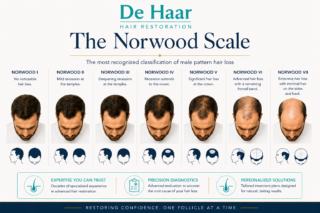
Advanced hair loss does not automatically rule out transplantation. However, expectations become especially important. A patient with a Norwood VI or VII pattern may have a large recipient area and a comparatively limited donor supply. Even an excellent donor area cannot necessarily recreate the density that existed before hair loss began. The objective may instead be to use the available follicles where they will have the greatest visual impact. Hair caliber, curl, color contrast and the number of hairs contained within each follicular unit all influence how much apparent coverage those grafts can provide. This is why two people with similar patterns of baldness and the same number of transplanted grafts can ultimately look quite different.
Previous Hair Transplants Should Be Evaluated
Some patients considering surgery after 60 underwent hair transplantation many years or even decades ago. Older procedures may have used techniques that differ considerably from modern follicular-unit transplantation. Patients may have visible plugs, unnatural hairlines, donor scars, reduced donor density or progressive hair loss surrounding previously transplanted areas. In these situations, the surgeon must evaluate both the previous transplant and the remaining donor supply. Depending on the circumstances, modern transplantation may be used to add density, soften an older hairline, camouflage scarring or improve the integration of previously transplanted hair. Repair surgery, however, requires individualized planning because some of the donor supply has already been used.
Results Still Require Time
Older patients should expect the same basic biological process that occurs after transplantation at younger ages. The transplanted follicles typically enter a resting phase after surgery, and many of the transplanted hairs shed during the first several weeks. This shedding does not mean that the follicles have been lost. New growth generally begins gradually over the following months. The appearance continues to change as additional hairs emerge and the shafts mature. Hair transplantation should therefore never be judged by the first few months. Final maturation commonly takes approximately 12 months and sometimes longer, particularly in certain areas such as the crown. One of the most important conversations with an older patient involves expectations. Successful hair restoration does not have to mean recreating the amount of hair someone had decades earlier. A carefully designed hairline, additional frontal coverage or improved density may significantly change the way the hair frames the face while still looking entirely appropriate for the patient’s age. The best results often do not call attention to the transplant at all. They simply look like the patient’s own hair.
So, Are You Too Old for a Hair Transplant?
For most people, the answer is No. You are not too old. Transplant candidacy has little to do with chronological age and more to do with health, donor quality, hair characteristics, extent of hair loss and realistic expectations. A healthy patient in their 60s or 70s with an appropriate donor area may be a great candidate for hair transplantation. A one on one, personal consultation with Dr Gerbrands includes an in-depth assessment of your scalp and donor area, will give you the answer as well as provide you with all options available to you to help maintain, revive and restore your hair to it’s maximum potential..
