
Few forms of hair loss are as sudden or as emotionally distressing as alopecia areata. Many people first notice a smooth, round patch of hair missing from their scalp, beard, eyebrows, or other areas of the body. Because it often develops without warning, it can be alarming and leave people wondering what caused it and whether their hair will grow back. Unlike male or female pattern hair loss, alopecia areata is not caused by genetics alone, aging, poor circulation, or inadequate hair care. It is an autoimmune condition in which the immune system mistakenly attacks healthy hair follicles, temporarily interrupting the normal hair growth cycle. Although the condition can be unpredictable, it is important to understand that the hair follicles usually remain alive. This means that, with appropriate treatment and ongoing management, hair regrowth is often possible. Early diagnosis also helps distinguish alopecia areata from other causes of hair loss and allows treatment to begin as soon as possible.
What Is Alopecia Areata?
Alopecia areata is an autoimmune condition that causes the immune system to mistakenly attack healthy hair follicles, disrupting the normal hair growth cycle and resulting in hair loss. Unlike many other forms of hair loss, the follicles themselves are usually not permanently damaged. Instead, the immune attack causes the follicles to enter a dormant state, temporarily stopping hair production. This is why hair often has the potential to regrow once the inflammation subsides or responds to treatment. The condition most commonly appears as one or more smooth, round patches of hair loss on the scalp, but it can also affect the beard, eyebrows, eyelashes, and other areas of the body. While some people experience only a single episode, others may have recurring episodes of hair loss or more extensive involvement over time. The severity and pattern of alopecia areata vary considerably from person to person, making it an unpredictable condition.
Although the exact cause is not fully understood, alopecia areata is believed to result from a combination of genetic susceptibility and environmental triggers that cause the immune system to lose its normal tolerance of the hair follicle. Researchers continue to study why this occurs, but it is clear that alopecia areata is not caused by poor hair care, inadequate nutrition, or a scalp infection. It is also not contagious and cannot be passed from one person to another. One of the most reassuring aspects of alopecia areata is that, unlike scarring forms of hair loss, the hair follicles generally remain alive beneath the skin. Because the follicles are preserved, spontaneous regrowth is possible, and many patients respond well to treatment. However, because the condition can be unpredictable, early diagnosis and ongoing monitoring are important to help manage flare-ups, encourage regrowth, and identify any associated autoimmune conditions that may require medical attention.
What Causes Alopecia Areata?
The exact cause of alopecia areata is not yet fully understood, but research has shown that it is an autoimmune disease. In people with alopecia areata, the immune system mistakenly identifies healthy hair follicles as a target and attacks them. This immune response interrupts the normal hair growth cycle, causing affected hairs to stop growing and eventually fall out. Scientists believe that alopecia areata develops as the result of several factors working together rather than a single cause. Genetics appear to play an important role, as the condition is more common in people with a family history of alopecia areata or other autoimmune diseases. However, not everyone who inherits a genetic predisposition will develop the condition, suggesting that environmental factors also contribute. Although stress is often blamed for alopecia areata, there is no evidence that stress alone causes the disease. Emotional or physical stress may act as a trigger in some people who are already genetically susceptible, but it is unlikely to be the sole cause. Other possible triggers being studied include viral infections, illness, hormonal changes, and other events that influence the immune system. In many cases, however, no obvious trigger can be identified. People with alopecia areata are also more likely to have other autoimmune conditions, including thyroid disease, vitiligo, type 1 diabetes, rheumatoid arthritis, lupus, and atopic dermatitis. This association further supports the theory that the condition results from an abnormal immune response rather than a problem with the hair itself. One of the most important things to understand is that alopecia areata is not caused by poor nutrition, inadequate hair care, wearing hats, or using the wrong shampoo. It is also not contagious and cannot be passed from one person to another. Because the hair follicles usually remain alive beneath the skin, treatment focuses on calming the immune response, encouraging hair regrowth, and managing the condition over time.
For many patients, one of the most frustrating aspects of alopecia areata is not knowing why it happened. While it’s natural to search for a specific cause, it’s important to remember that this condition is rarely the result of something you did or didn’t do.
Signs and Symptoms of Alopecia Areata
Alopecia areata most commonly presents as one or more smooth, round or oval patches of hair loss that develop suddenly over a period of days or weeks. The affected skin usually appears healthy, with no significant redness, scaling, or scarring. Many people are surprised to discover these patches while brushing or washing their hair, or after a family member or hairdresser points them out. Although the scalp is the most frequently affected area, alopecia areata can occur anywhere hair grows. Some people develop hair loss in the beard, eyebrows, eyelashes, or other areas of the body. The pattern and extent of hair loss vary considerably from person to person. While some individuals experience only a single small patch that regrows completely, others may develop multiple patches or more widespread hair loss over time. One of the characteristic features of alopecia areata is the presence of “exclamation mark” hairs. These are short hairs that are narrower at the base and slightly wider toward the tip, giving them the appearance of an exclamation mark. They are often found around the edges of an active patch of hair loss and can be an important clue during clinical examination. Some people notice mild itching, tingling, tenderness, or a burning sensation in the affected area before the hair falls out, although many experience no discomfort at all. In addition to changes in the hair, a small percentage of people with alopecia areata also develop changes to their fingernails or toenails. These may include small pits or indentations in the nail surface, ridging, roughness, thinning, or increased brittleness. While nail changes are not present in every patient, they can provide additional clues that support the diagnosis. One of the challenges of alopecia areata is its unpredictability. Hair may regrow completely in one area while new patches develop elsewhere, or periods of regrowth may be followed by recurrence months or even years later. Because the condition varies so widely between individuals, an accurate diagnosis and ongoing follow-up are important to monitor disease activity and adjust treatment when necessary.
You should arrange an assessment if you notice sudden patchy hair loss, rapidly expanding areas of thinning, loss of eyebrows or eyelashes, or repeated episodes of unexplained hair loss. Early diagnosis helps distinguish alopecia areata from other causes of hair loss and allows treatment to begin before the condition progresses.
The Different Types of Alopecia Areata
Alopecia areata does not affect everyone in the same way. While some people develop a single small patch of hair loss that regrows completely, others experience more extensive or recurring hair loss. Understanding the different forms of alopecia areata can help explain why the condition varies so greatly from one person to another and why treatment recommendations are individualized.
Patchy Alopecia Areata
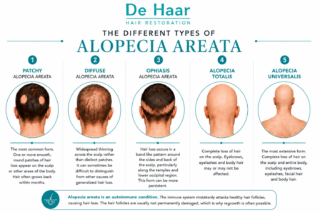
Patchy alopecia areata is the most common form of the condition. It typically presents as one or more smooth, round or oval patches of hair loss on the scalp, although the beard, eyebrows, eyelashes, and other areas of the body may also be affected. The patches often develop suddenly and are usually free of redness, scaling, or scarring. Many people experience complete regrowth within several months, either spontaneously or with treatment, although new patches may develop in the future.
Alopecia Totalis
Alopecia Totalis is a more advanced form of alopecia areata in which all of the hair on the scalp is lost. Some people progress from a few small patches to complete scalp hair loss over weeks or months, while others experience a more gradual progression. Although this form of the disease can be more difficult to treat, hair regrowth is still possible because the hair follicles usually remain alive beneath the skin. Treatment often requires a more comprehensive medical approach and close follow-up.
Alopecia Universalis
Alopecia universalis is the most extensive form of alopecia areata. In addition to complete loss of scalp hair, it involves the loss of eyebrows, eyelashes, beard hair, and hair on the rest of the body. While this form is relatively uncommon, it can have a significant emotional and psychological impact. Newer targeted immune therapies have improved treatment options for some patients, although the response varies from person to person.
Diffuse Alopecia Areata
Unlike the classic patchy form, diffuse alopecia areata causes widespread thinning across the scalp rather than distinct bald patches. Because it often resembles telogen effluvium or early female pattern hair loss, diagnosis can sometimes be challenging. A careful clinical examination and Trichoscopy are often needed to distinguish diffuse alopecia areata from other causes of generalized hair thinning.
Ophiasis Alopecia Areata
Ophiasis alopecia areata is an uncommon pattern in which hair loss occurs in a band-like distribution around the sides and back of the scalp, particularly along the temples and lower occipital region. This pattern tends to be more persistent than the typical patchy form and may respond less predictably to treatment. Early diagnosis and appropriate management are important to help maximize the potential for hair regrowth.
Treatment Options for Alopecia Areata
There is currently no permanent cure for alopecia areata, but there are several treatments that may help reduce inflammation, encourage hair regrowth, and manage the condition over time. The most appropriate treatment depends on several factors, including the extent of hair loss, the age of the patient, how long the condition has been present, and whether it is stable or actively progressing. Because alopecia areata is an autoimmune disease, treatment is aimed at calming the immune system’s attack on the hair follicles rather than treating the hair itself. Since the hair follicles usually remain alive beneath the skin, many patients have the potential to experience partial or complete hair regrowth once the inflammation has been controlled.
For patients with one or two small patches of hair loss, corticosteroid injections into the affected areas are often considered one of the most effective first-line treatments. These injections help reduce local inflammation around the hair follicles and may encourage new hair growth over the following weeks or months. In some cases, topical corticosteroid creams or solutions may also be prescribed, particularly for children or for areas where injections are less practical. For patients with more extensive or rapidly progressing alopecia areata, additional treatment options may be recommended. Depending on the individual situation, these may include topical immunotherapy, oral medications that modify the immune response, or newer targeted therapies known as JAK inhibitors. These medications have significantly improved treatment options for some patients with moderate to severe alopecia areata, although they are not appropriate for everyone and require careful medical supervision. Topical minoxidil may also be recommended in selected patients. While it does not treat the underlying autoimmune condition, it may help support hair regrowth when used alongside other treatments. Because alopecia areata is unpredictable, treatment requires patience. Hair regrowth often takes several months, and newly growing hair may initially appear fine or white before gradually regaining its normal colour and thickness. Some patients experience complete regrowth, while others may have recurrent episodes throughout their lives. Regular follow-up allows treatment to be adjusted as the condition changes over time.
Hair transplantation is generally not recommended while alopecia areata is active. Unlike pattern hair loss, where transplanted hair follicles are usually permanent, the immune system in alopecia areata may continue to attack both existing and transplanted hair follicles. For this reason, treatment is focused on controlling the autoimmune process before surgical options are ever considered. In carefully selected patients with long-standing, stable disease, hair transplantation may be possible, but only after a thorough assessment and when the risk of recurrence is considered low.
Living with alopecia areata can be emotionally challenging, particularly when the hair loss is extensive or recurrent. In addition to medical treatment, many patients benefit from cosmetic options such as eyebrow restoration techniques, scalp camouflage products, or counselling and support groups. Addressing the emotional impact of hair loss is an important part of comprehensive care and should not be overlooked.
Is Hair Transplantation an Option?
Hair transplantation is generally not recommended for patients with active alopecia areata. Unlike male and female pattern hair loss, where hair transplantation has a well-established role, alopecia areata is an autoimmune disease in which the immune system attacks the hair follicles. If the condition is active, transplanted follicles may also become targets of the immune response, making the outcome unpredictable. For this reason, the primary goal is to control the disease first, encourage natural hair regrowth where possible, and ensure the condition has remained stable before considering any surgical treatment.
In carefully selected cases, hair transplantation may be discussed for patients who have experienced long-term disease stability with no evidence of active inflammation or recurring hair loss. Even then, a thorough assessment is essential, and patients must understand both the potential benefits and the limitations of surgery. At De Haar Hair Restoration, our approach is always to recommend the treatment that offers the best long-term outcome. If a hair transplant is unlikely to provide predictable, lasting results, we believe it is more appropriate to explore medical therapies or other treatment options first, reserving surgery for those patients who are most likely to benefit. We are highly experienced in treating patients with Alopecia Areata giving them the best options for restoring their hair.
Key Takeaways
- Alopecia areata is an autoimmune disease in which the immune system mistakenly attacks healthy hair follicles, interrupting the normal hair growth cycle.
- The hair follicles are usually not permanently damaged, which means many people experience partial or complete hair regrowth, either naturally or with treatment.
- The condition is unpredictable. Some people develop a single small patch that regrows completely, while others may experience recurrent episodes or more extensive hair loss.
- Early diagnosis is important. Alopecia areata can resemble other forms of hair loss, and identifying the correct diagnosis allows the most appropriate treatment to begin as early as possible.
- Several effective treatment options are available. Although there is currently no permanent cure, many therapies can help reduce inflammation, encourage hair regrowth, and manage the condition over time.
- Hair transplantation is generally not recommended while the disease is active. The priority is first to control the autoimmune process and ensure the condition has remained stable before surgical options are considered.
- Successful management begins with understanding the condition. Knowing what alopecia areata is, what causes it, and what treatment options are available allows patients to make informed decisions about their care.
Conclusion
Alopecia areata can be a frightening diagnosis, particularly when hair loss develops suddenly and without warning. Although its unpredictable nature can be frustrating, it is important to remember that alopecia areata is a treatable medical condition, not a reflection of your overall health or something you have done wrong. Because the hair follicles usually remain alive beneath the skin, many people experience significant hair regrowth with time, appropriate treatment, or a combination of both.
Every person’s experience with alopecia areata is unique, which is why an accurate diagnosis and individualized treatment plan are so important. Understanding the type of alopecia areata you have, assessing how active the condition is, and identifying any associated autoimmune conditions all help guide the most appropriate course of treatment. While some patients recover quickly, others require ongoing management and regular follow-up to monitor changes over time.
At De Haar Hair Restoration, we believe that successful hair restoration begins with understanding the cause before recommending a treatment. Our focus is on providing a comprehensive assessment, an accurate diagnosis, and honest, evidence-based recommendations tailored to each individual. Whether treatment involves medical therapy or in carefully selected situations, surgical hair restoration, our goal is always the same, helping you to make informed decisions and achieve the best possible long-term outcome.
If you have noticed sudden patchy hair loss or are concerned about changes in your hair, seeking a professional assessment is the first step. Understanding why your hair loss is occurring provides the foundation for effective treatment and the confidence to move forward with a plan that’s right for you. At De Haar every hair restoration journey begins with an accurate diagnosis.
One comment
Pingback: Hair Loss Diagnosis: Your Complete Guide to Understanding the Cause Before Choosing Treatment – De Haar Hair Restoration
Comments are closed.