
Donor Graft Quantity in Hair Transplantation: Why It Matters
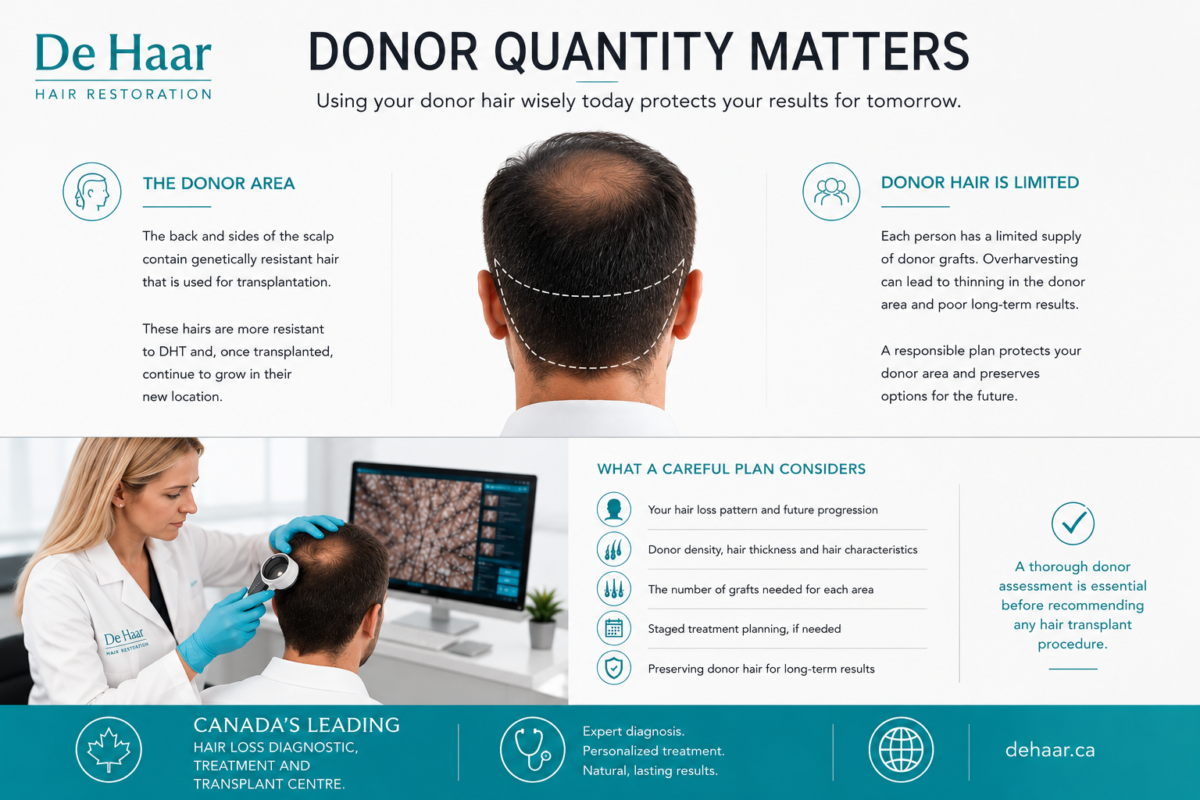
When people think about a hair transplant, they often focus on the area where they want more hair: The hairline, temples, crown, or thinning top of the scalp, but one of the most important parts of a successful hair transplant is actually the area where the hair comes from. This is called the donor area. In hair transplantation, donor quantity matters because every person has a limited amount of donor grafts. Once it has been used, it cannot be replaced. This makes careful planning essential, especially for patients with advanced hair loss or ongoing thinning. At De Haar Hair Restoration, every transplant plan begins with understanding not only where you are losing hair, but also how much donor hair is safely available to create a natural and lasting result.
Where is the donor area and what is special about it?
The donor area is located at the back and sides of the scalp. These hairs are genetically resistant to the effects of DHT, the hormone involved in androgenetic alopecia, also known as male or female pattern hair loss. Because these hairs are resistant to thinning and considered permanent, they are used for transplantation into areas where hair has been lost. Once transplanted, these follicles continue to grow in their new location throughout your life because they retain the permanence characteristics of the donor area.
Donor hair grafts are limited in supply so quantity matters
One of the biggest misconceptions about hair transplantation is that a surgeon can simply “move as much hair as needed.” In reality, you have a limited supply of donor hair. A person with strong donor density may have more grafts available for transplantation. A person with lower density, fine hair, scarring, previous surgery, or diffuse thinning may have fewer usable grafts. This is why donor quantity assessment is one of the most important aspects of a hair transplant consultation. Your donor quantity determines how much coverage can realistically be achieved without leaving you looking thin and balding in the donor area.
Donor density affects;
- How many grafts can be safely harvested
- Which areas should be prioritized
- How dense the result can look
- Whether the crown can be restored
- Whether future procedures may be possible
- How natural the transplant will look over time
A good hair transplant is not simply about using the highest number of grafts. It is about using the right number of grafts in the right places.
Protecting your donor area is vital
Overharvesting is one of the greatest risks in hair transplantation. If too many grafts are removed from the donor area, the back and sides of the scalp can begin to look thin, patchy, or depleted. This can be difficult or impossible to fully correct. A responsible surgical plan protects the donor area so that it continues to look natural after surgery. The goal is not only to restore the front or top of the scalp, but also to preserve the appearance of the donor area.
More grafts does not always mean a better result
Many patients are attracted to clinics that advertise very large graft numbers. While graft count is important, more is not always better. A very high graft number can be harmful if it exceeds what the donor area can safely provide.
Natural looking results depends on:
- Proper graft selection
- Careful hairline design
- Correct angles and direction
- Strategic placement
- Donor preservation
- Long-term planning
Using too many grafts too early can create problems later, especially if hair loss continues.
Remember that hair loss is progressive
Most forms of pattern hair loss continue over time. This means a patient may restore the hairline today but continue thinning behind it in the future. If all available donor grafts are used in one procedure without long-term planning, there may not be enough donor hair left to address future loss. This is why an experienced hair transplant surgeon think years ahead and understands your hair loss pattern and how your loss is most likely to progress. A successful transplant should not only look natural now but remain appropriate as the you age.
For patients with extensive hair loss, donor quantity becomes even more important. There may not be enough donor hair to recreate the density a person had in youth across the entire scalp. In these cases, the goal is to create the best possible cosmetic improvement using the available donor supply without overharvesting. Often, priority is given to the frontal hairline and mid-scalp because these areas frame the face and create the greatest visual impact. The crown may require a large number of grafts and can be more challenging to fully restore, especially if donor supply is limited.
How hair characteristics affect coverage
Donor quantity is not only about the number of grafts. Hair characteristics also matter. For example, coarse or curly hair often provides more visual coverage than fine, straight hair. Dark hair against light skin may show thinning more easily than hair with lower colour contrast. This is why two patients with the same graft count can have very different-looking results.
Coverage is influenced by:
- Hair thickness
- Hair colour
- Hair texture
- Curl or wave
- Contrast between hair and scalp colour
- Number of hairs per graft
- Donor density
Donor quality matters too
Quantity is important, but quality is just as critical. A strong donor area has healthy, stable follicles that are suitable for transplantation. Before recommending surgery, a thorough diagnostic assessment should confirm that the donor hair is appropriate for transplantation.
Why the diagnosis of your type of hair loss is important
Not all hair loss is suitable for hair transplantation. Certain conditions, including some scarring alopecia’s, autoimmune-related hair loss, uncontrolled inflammation, or diffuse shedding conditions, may affect whether surgery is safe or appropriate. If the underlying cause of hair loss is not properly diagnosed, even a technically well-performed transplant may fail to deliver the desired result.
At De Haar Hair Restoration, diagnosis is central to all treatment planning because the best results begin with understanding why hair loss is happening in the first place.
Donor planning in FUE and FUT hair transplants
Both FUE and FUT use donor hair, but they harvest it differently. In FUE, individual follicular units are removed one at a time from the donor area. This avoids a linear scar but requires careful spacing to prevent overharvesting. In FUT, a strip of tissue is removed from the donor area and dissected into grafts. This leaves a thin linear scar that is covered with the surrounding hair. FUT is useful in certain cases where you have extensive balding and maximizing your graft numbers is important. The best method depends mainly on your health, type of hair loss, your donor supply, hair loss pattern, goals, hairstyle preferences, and long-term plan.
Donor graft quantity and crown restoration
The crown is one of the most graft-demanding areas of the scalp. Because the crown has a circular growth pattern, it can require many grafts to achieve visible density. In patients with limited donor supply, restoring the crown too aggressively may take grafts away from areas that create more visual impact. This does not mean the crown cannot be treated. It means it must be planned carefully. Sometimes medical therapy, PRP, low-level laser therapy, or staged surgery may be recommended to support the best long-term outcome.
An excellent hair transplant is about strategy
Hair transplantation is not simply about moving hair from one place to another. It is about creating the best cosmetic result with a limited biological resource.
This requires:
- Accurate diagnosis
- Careful donor assessment
- Realistic graft planning
- Artistic hairline design
- Long-term thinking
- Protection of future options
The most successful results come from using donor hair wisely, not aggressively.
Why donor quantity matters at De Haar Hair Restoration
At De Haar Hair Restoration, we understand that every graft matters. Your donor hair is finite, and our goal is to use it in a way that creates the most natural, balanced, and most sustainable result possible. Before recommending surgery, we evaluate your hair loss pattern, donor density, scalp health, hair characteristics, medical history, and long-term goals. This allows us to design a treatment plan that protects your donor area while achieving meaningful improvement.
Final thoughts
Donor quantity is one of the most important factors in hair transplantation. It determines what is possible, what should be prioritized, and how your result may look years into the future. A successful hair transplant is not about using the most grafts. It is about using the right grafts, in the right places, with a plan that respects your limited donor supply. When donor hair is managed carefully, hair transplantation can create natural, lasting results that enhance your appearance while preserving options for the future.
