
About Non-Surgical Hair Restoration
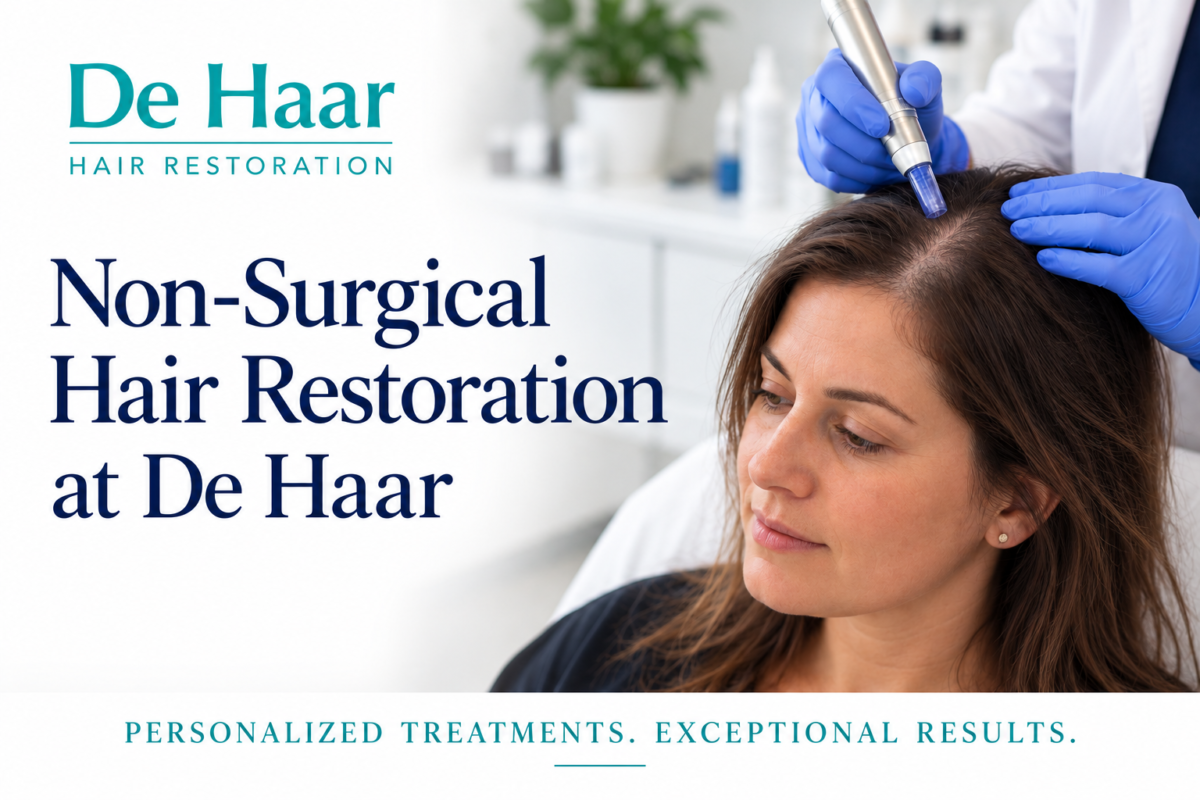
When people think about hair restoration, they often think immediately about a hair transplant with surgery. Surgery is only one part of modern hair restoration. For many men and women experiencing thinning, shedding, or early hair loss, non-surgical hair restoration treatment may be the first or sometimes the only treatment needed. At De Haar Hair Restoration non-surgical treatment begins with something that is easily overlooked. Determining why the hair is being lost in the first place.
Hair loss is a symptom, not a single diagnosis. Genetics, hormones, nutritional deficiencies, medications, autoimmune disease, inflammatory scalp conditions, illnesses, stress and other medical factors can all contribute to changes in the hair. That means a treatment that is appropriate for one patient may be completely wrong for another. Once the underlying cause and condition of the follicles are understood, a personalized treatment plan can be developed. Depending on the diagnosis, this may include medication, regenerative therapies, microneedling, PRP, low level light therapy, or other non-surgical approaches.
Medical Treatment for Hair Loss
Some of the most effective non-surgical approaches to hair loss are medications. For androgenetic alopecia, better known as male or female pattern hair loss, medications may be used to slow progressive loss, preserving existing follicles and in many patients, improve the quality of miniaturized hair. Options may include minoxidil, finasteride, dutasteride, or other prescription therapies depending upon the patient’s diagnosis, gender, medical history, and individual circumstances. Medication can be particularly important because hair transplantation does not stop the progression of hair loss in the surrounding non transplanted area. For some patients, stabilizing the existing hair is therefore an important part of a long term restoration plan, even if they eventually choose to have a transplant.
PRP : Using Your Own Platelets to Support Hair Follicles
Platelet Rich Plasma, or PRP, is one of the regenerative treatments available at De Haar. PRP begins with a small amount of the patient’s own blood. The blood is processed to concentrate the platelets within the plasma. These platelets contain growth factors and signaling proteins involved in tissue repair and cellular communication. The concentrated plasma is then delivered to the areas of thinning. The objective is to support hair follicles that are still alive but have become weakened or miniaturized. PRP does not manufacture new follicles in the area where they no longer exist. This distinction is very important. Someone with early to moderate thinning may have thousands of follicles that are still present but producing increasingly fine hairs or have ceased to produce hair yet they are still viable. Supporting these existing follicles is very different from attempting to restore a smooth, longstanding bald area. At De Haar Hair Restoration, PRP may be used independently or incorporated into a broader treatment plan involving other therapies.
Microneedling and Regenerative Treatments
Microneedling is another non-surgical approach available at De Haar. The treatment uses very fine needles to create controlled microscopic channels in the scalp. This stimulates the body’s natural wound healing response and activates biological signaling involved in tissue repair. Microneedling can also be combined with selective, regenerative biological products. Depending upon the patient’s treatment plan microneedling may be used in conjunction with other therapies such as PRP, exosomes, peptides, or other biologic preparations. The objective is not simply to place a product on the scale. Microneedling creates controlled micro-injury while allowing treatment to reach the scalp more directly. For patients with miniaturized but viable follicles, this can form part of a broader strategy designed to support follicular health. Microneedling can also be used post-transplant to support the new growth and stimulate the follicles surrounding the transplanted follicles.
Low Level Light Therapy
Low level light therapy or LLLT is another option that may be incorporated into non-surgical hair restoration. LLLT uses specific wavelengths of light to interact with cells within the scalp. The treatment is intended to support cellular activity and follicular function without surgery or injections. Because it is noninvasive, light therapy can also be incorporated into a broader treatment program rather than being used alone. De Haar Hair Restoration also includes low level light therapy as part of its post-transplant care in appropriate patients.
Scalp Micropigmentation
Not every surgical treatment needs to stimulate hair growth. Sometimes the objective is to improve the visual appearance of density. Scalp micropigmentation, or SMP, uses specialized pigment. placed within the scalp to reduce the visual contrast between the hair and exposed scalp. For someone with thinning hair, this can make the scalp less noticeable and give the appearance of greater density. SMP can also be used in areas without the hair to create the appearance of closely shaped follicles. It can be particularly useful for selected patients who are not transplant candidates but prefer a non-surgical cosmetic solution to have the appearance of more density.
Diagnosing Hair Loss
Sometimes the hair is telling us that something else is happening. Excessive shedding can occur with thyroid abnormalities, nutritional deficiencies, hormonal changes, illness, medications, significant stress and systemic conditions. Hair loss can also result from autoimmune and inflammatory scalp diseases. Some forms of scarring alopecia can permanently damage the follicles if the underlying disease is not recognized and treated. In these situations, simply applying a hair growth product without identifying the underlying condition may delay appropriate treatment risking loss of viable follicles. This is why diagnosis is such an important part of the De Haar approach. Doctor Bea Gerbrands specializes in diagnosing and treating both common and rare forms of hair loss and scalp diseases. A comprehensive evaluation can include trichoscopy, examination of the scalp and follicles, assessment of the pattern of loss and when appropriate, further medical investigation.
Can Non-Surgical Treatments Prevent a Hair Transplant?
A patient experiencing early hair loss may be able to preserve and improve enough existing hair that transplantation may become unnecessary or in certain cases can be postponed. For another patient, non-surgical treatment may help stabilize progressive loss before surgery. For someone with significant permanent follicular loss, non-surgical therapy may not provide enough restoration by itself. In such cases transplantation may then be the more appropriate way to replace the hair in areas where viable follicles are no longer present. There is also another possibility, which is combining the two approaches. A hair transplant can restore follicles to areas where there have been permanently lost, while medical or regenerative treatments may be used to support the patients remaining native hair surrounding the transplant. Modern hair restoration does not always have to be an either or decision.
Which Non-surgical Hair Restoration Treatment is Right for You?
There is no single non-surgical treatment that is best for everyone. The right treatment depends upon the cause of the hair loss, whether the follicles remain viable, how advanced the hair loss has become, and what the patients goals are. At De Haar, non-surgical options may include medical therapy, low level light therapy, microneedling with regenerative biologic products, in-office treatments. Steroidal injections, scalp micropigmentation, and individualized combination therapies. For some patients the goal is to reduce shedding, and for others it is to strengthen miniaturized hair. Some want to preserve as much existing hair as possible before considering surgery or other treatments, and others simply want to understand what is happening with their hair. This is why the first step is not choosing a treatment from a menu; it is getting the diagnosis right. At De Haar Hair Restoration, Dr. Bea Gerbrands evaluates the hair, scalp, and pattern of loss before developing an individualized treatment strategy. Surgery may be part of that plan, but increasingly there are many things we can do for hair loss without surgery at all. If you are experiencing hair loss it is important to understand the cause so that appropriate treatment can be initiated early if necessary. In certain circumstances such as with scarring alopecias early intervention is extremely important to help prevent permanent loss of the follicles.
