
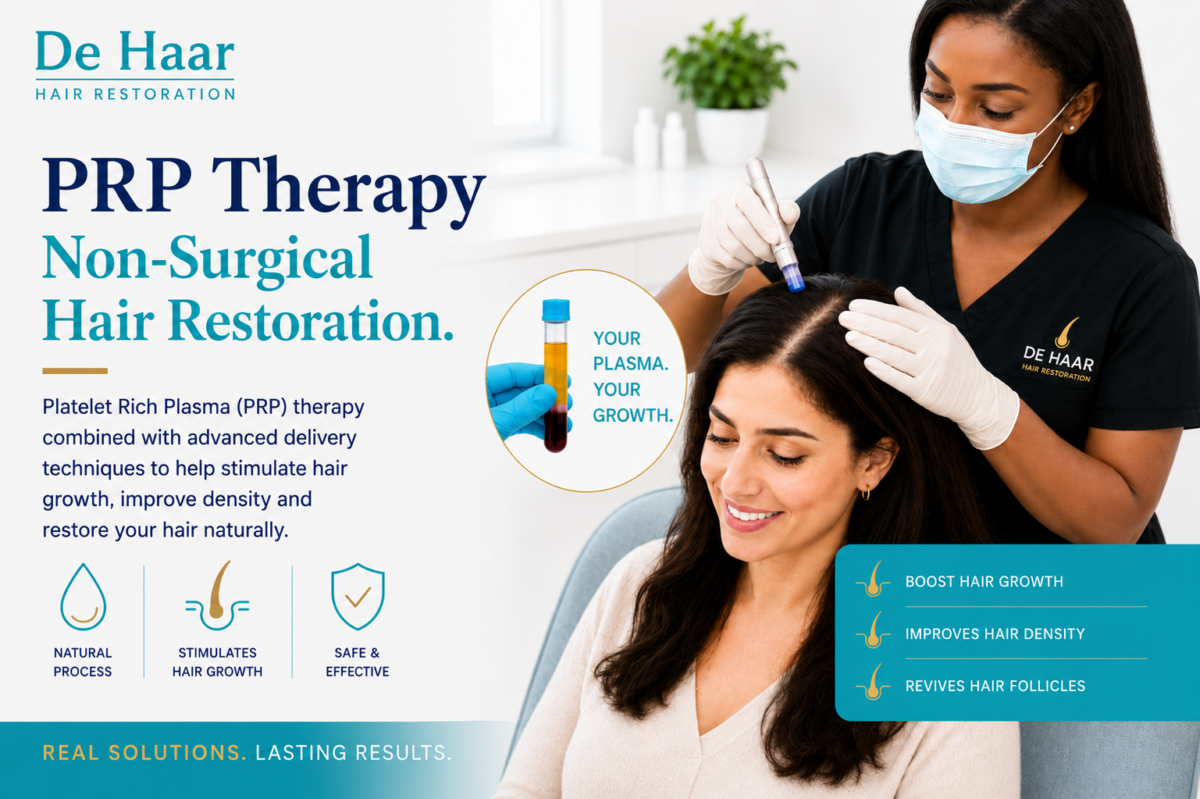
One of the most widely utilized non surgical treatments for hair restoration is platelet-rich plasma (PRP) therapy . PRP therapy has gained attention for its potential to stimulate dormant hair follicles, prolong the hair growth cycle, and improve scalp health using the patient’s own blood. PRP is one of the most natural, biologically based approaches to hair restoration and remains one of the most compelling regenerative options available today. Originally used in orthopedics, dentistry and wound healing, PRP is now commonly used in hair restoration. PRP is not a cure for baldness but is an important adjunct therapy in comprehensive hair loss management when used appropriately with realistic expectations.
What is platelet-rich plasma PRP?
Platelet-rich plasma is a concentration of platelets in serum (plasma) derived from the patient’s own blood. Platelets are best known for their role in blood clotting, but they also contain hundreds of biologically active proteins and growth factors that play a critical role in tissue repair and cellular regeneration. Blood is drawn from the patient and processed in a centrifuge which separates the blood into layers isolating the plasma. This plasma has a higher than normal concentration of platelets. The resulting PRP fluid is then used on targeted areas of the scalp. Because PRP is autologous, meaning it’s derived from the patient’s own body, the risk of allergic reaction or disease transmission is extremely low.
How does PRP work for hair loss?
Hair follicles are composed of the most active cells in the body. Hair follicles go through a cycle of phases. The growth phase ( anagen), resting phase (catagen ) and shedding phase (telogen). In androgenetic alopecia, follicles are damaged and gradually miniaturize, producing thinner shorter hairs until they eventually stop producing viable hair altogether. The growth phase shortens and eventually the weakened follicles become redundant. PRP supports the hair follicle and hair growth through several biological mechanisms. PRP is packed with platelets that release growth factors. These molecules stimulate stem cells and dermal papilla in the hair follicle and play a key role in the development and cycling of the hair. PRP assists in the formation of new blood vessels, improving oxygen and nutrient delivery to hair follicles, Blood circulation is particularly important in areas affected by hair thinning. Evidence suggests that PRP can help prolong the antigen or growth phase of the hair cycle resulting in thicker, longer lasting hair strands. PRP also has anti-inflammatory properties that improve scalp health and create a more favorable environment for hair growth. It assists with chronic low-grade inflammation of the scalp which contributes to hair loss in certain individuals. PRP is most commonly used in men and women with early to moderate androgenetic alopecia; it works best when follicles are still present but weakened or damaged rather than in areas of complete baldness. PRP also helps to accelerate recovery from telogen effluvium which is stress related shedding.
Does PRP help in autoimmune related hair loss?
Autoimmune hair loss results may vary as PRP is not considered a first line therapy, but it has shown to help in some select cases. Depending on your particular circumstances, your hair loss specialist can help you decide if this will be an effective or helpful therapy for you.
Can PRP be used with a hair transplant?
PRP is frequently used before, during and after hair transplant surgery to enhance graft survival, speed healing and improve overall hair quality. It is an excellent adjunct therapy to a hair transplant to keep your hair surrounding the transplanted hair healthy and strong.
What is the process of PRP?
Approximately 10-20 ml of blood is drawn from the patient and then placed in a centrifuge. The centrifuge separates the red blood cells from the plasma which contains the vital nutrients, proteins and growth factors, The nutrient dense plasma is then drawn off and delivered to the hair follicles through microneedling channels placed on the scalp through the use of a specialized device. The procedure itself takes approximately 30-45 minutes. It is recommended that PRP be done in sessions, once every 4 weeks for 6 weeks then once or twice a year to maintain your results.
Can PRP be used with other therapies?
PRP is often used in combination with other therapies for the treatment of hair loss. Although effective on its own, PRP results can be boosted. It is commonly used with microneedling alongside topical medications such as minoxidil, topical finasteride and serums containing exosomes. Treatment with Glutathione as a booster can also be done with PRP and has shown excellent results.
When will I see results?
Within 2 to 3 months, you will experience greatly reduced shedding and by 3 to 6 months, improved thickness and texture are noticeable. Between 6 and 12 months you will see a visible improvement in density, quality and quantity of the hair with a noticeable increase in strength and diameter of the hair shaft. It is important to remember that PRP does not create new hair follicles, its effectiveness lies in its ability to regenerate damaged and weakened follicles and those that are dormant but still alive. PRP is a supportive or adjunctive therapy and not a standalone cure for hair loss. PRP is not effective if the hair follicles are not viable meaning that It is not effective in completely bald areas where there are no living follicles. It is important to note that the results need to be maintained. Popular maintenance regimes often include medications and/or occasional PRP supportive treatments in order to maintain the hair at its maximum potential.
Can anyone have PRP treatments?
- PRP may not be appropriate for people with platelet disorders or severe anemia
- those with active scalp infections or inflammatory scalp disease
- certain autoimmune conditions (assessed on a case by case basis)
- active cancer or bloodborne malignancies
- ongoing anti-coagulant therapy
What are the side effects of PRP?
Mild to moderate discomfort at the injection site may be possible and this usually subsides within a few hours. Swelling, redness and tenderness is possible but typically subsides in 24 to 48 hours. There’s a slight chance of bruising at the injection sites and a possibility of temporary scalp itching or sensitivity. These effects normally resolve quickly and do not require special treatment beyond gentle care, for example avoiding strenuous activity and following aftercare instructions. Less common side effects can include infection at the injection site, but it is rare when sterile technique is used. Serious long-term complications are very rare in controlled clinical settings.
Is PRP safe?
PRP Therapy is considered very safe for hair loss when it is performed correctly by a trained medical professional. There is no risk of disease transmission, rejection or allergy to the PRP itself because PRP is autologous meaning that it uses the body’s own substances. The risk of a reaction is rare. PRP is considered a safe and effective method of reviving viable hair follicles. The procedure is minimally invasive. PRP has a long clinical history and has been used for decades in orthopedics, sports medicine, wound healing, dermatology and hair restoration.
Conclusion
Platelet-rich plasma (PRP) therapy has become an important part of modern hair restoration because it works with your body’s own natural healing mechanisms to support healthier, stronger hair. While it is not a cure for hair loss, PRP can help slow progression, reduce shedding, improve hair quality, and strengthen weakened follicles when they are still viable. The best results are achieved when treatment begins early and is tailored to the underlying cause of the hair loss.
At De Haar Hair Restoration, we believe that successful treatment begins with an accurate diagnosis. Not every patient is an ideal candidate for PRP, and not every type of hair loss responds in the same way. Our comprehensive hair loss assessments allow us to determine whether PRP is the right option for you or whether another treatment, or combination of treatments, will provide better long-term results.
If you’ve noticed increased shedding, thinning hair, or changes in hair density, don’t wait until significant hair loss has occurred. Early intervention offers the greatest opportunity to preserve existing hair and maximize treatment success. Contact De Haar Hair Restoration to schedule a comprehensive consultation and discover the treatment plan that’s right for you.
One comment
Pingback: About Non-Surgical Hair Restoration – De Haar Hair Restoration
Comments are closed.