
The Benefits of a Direct Hair Implant (DHI) Transplant
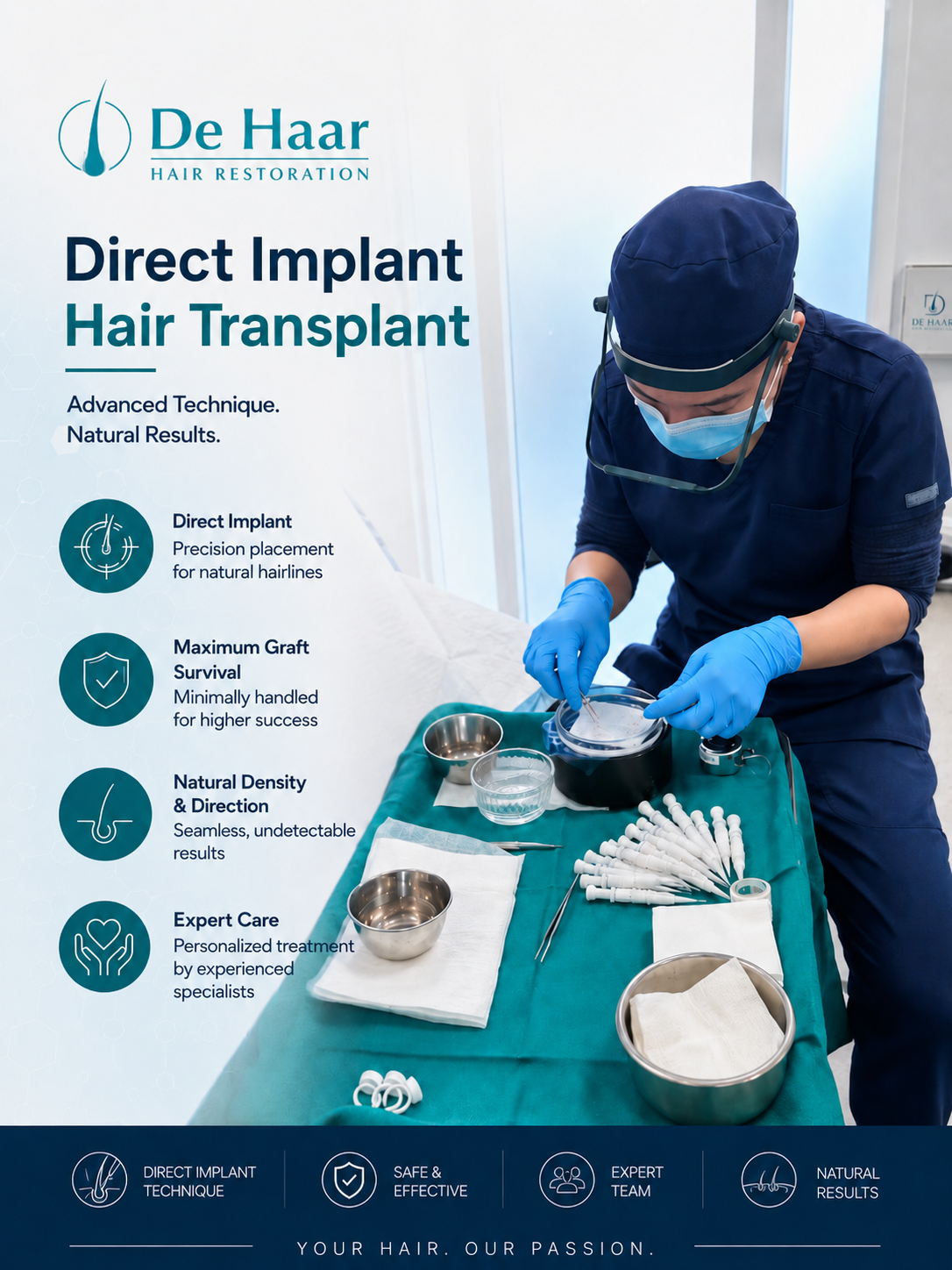
Hair transplantation has evolved dramatically over the last two decades. What was once considered a procedure that produced obvious, unnatural results has become a highly refined medical treatment capable of restoring hairlines with remarkable precision and naturalness. Among the most advanced techniques available today is the Direct Hair Implant Transplant, often referred to as the DHI method. At De Haar Hair Restoration, we believe that understanding your treatment options is the first step toward making an informed decision about your hair restoration journey. If you’re exploring surgical solutions for hair loss, here’s why a direct hair implant transplant has become one of the most sought-after techniques in modern hair restoration.
What Is a Direct Implant Hair Transplant?
A DHI transplant is an advanced variation of Follicular Unit Extraction (FUE). Individual follicular units are carefully extracted from the donor area and then implanted directly into the recipient area using a specialized implantation device. Unlike traditional methods that require the surgeon to first create recipient sites and then place grafts into those sites, the direct implant technique combines these steps into a single, controlled movement. This allows for exceptional precision during the placement process. The goal remains the same: to create natural, permanent hair growth using your own genetically resistant hair follicles. However, the direct implant method offers several unique advantages that can enhance both the procedure and the final outcome.
Exceptional Precision and Control
One of the greatest benefits of direct implantation is the level of precision it provides. Hair grows at specific angles, directions, and densities that vary across different regions of the scalp. The frontal hairline, temples, crown, and mid-scalp each require a unique approach. The direct implant technique allows the surgeon to carefully control hair angle, direction, depth and density. This precision is particularly important when creating a natural-looking hairline. Even minor variations in graft placement can significantly affect the final appearance. When performed by an experienced hair restoration surgeon, direct hair implantation can help recreate the subtle irregularities and softness found in a natural hairline.
Natural-Looking Results
Most patients aren’t simply looking for more hair, they want hair that looks completely natural. The direct implant method allows for meticulous placement of individual follicular units exactly where they are needed. Single-hair grafts can be positioned along the leading edge of the hairline to create a soft, feathered appearance, while multi-hair grafts can be strategically placed behind the hairline to build density. This results in softer hairline transitions, natural appearance, better blending with existing hair and a more refined aesthetic outcome.
Reduced Handling of Hair Grafts
Hair grafts are delicate living tissue. The less they are handled during the procedure, the better their chances of survival. With traditional implantation methods, grafts may be transferred multiple times before placement. The direct hair implant technique minimizes unnecessary manipulation by allowing grafts to be loaded directly into the implantation device and placed into the scalp with greater efficiency. Benefits include:
- Reduced graft trauma
- Improved graft protection
- Enhanced viability of transplanted follicles
- Higher-quality growth outcomes
Higher Graft Survival Rates
The success of a hair transplant depends on how many transplanted follicles successfully establish blood supply and begin growing in their new location. Because the direct implant method minimizes handling and allows efficient placement, many surgeons believe it can contribute to excellent graft survival. While surgical skill remains the most important factor, every step that protects the follicle helps support successful growth. Healthy graft survival translates into:
- Better density
- More consistent growth
- Fuller coverage
- Improved long-term results
Less Trauma to the Scalp
Direct hair implantation is more often a gentler approach to recipient area creation. Traditional techniques involve creating all recipient sites first and then placing grafts into those sites afterward. With direct hair implantation, site creation and graft placement occur simultaneously. This can reduce repetitive manipulation of the recipient area and allow for highly controlled placement. This is especially important for patients who still have existing hair in the recipient area. Potential benefits include:
- Reduced tissue trauma
- Less disruption to surrounding follicles
- Improved healing
- Enhanced comfort during recovery
Ideal for Hairline Restoration
Hairline design is one of the most technically demanding aspects of hair transplantation. A successful hairline must look natural not only today but also years into the future. The ability to recreate natural hair patterns is one of the reasons many patients specifically seek out direct implantation transplants. The DHI method excels in hairline restoration because it allows the surgeon to carefully place each graft with precise control over the direction, angle, spacing and density. This level of customization can be particularly beneficial for receding hairlines, temple and corner restoration, Female hairline lowering and gender affirming procedures.
Excellent for Women and Men
Hair loss affects both men and women, often in different ways. Women frequently experience diffuse thinning rather than distinct bald areas. Because existing hairs often remain throughout the treatment area, preserving those hairs becomes especially important. The direct implant technique can be advantageous because it allows for careful placement between existing hairs while minimizing disruption. This makes it a popular option for female pattern hair loss, scar camouflage, eyebrow restoration and density enhancement. Men also benefit from the technique when rebuilding hairlines, restoring corners and crown density, or addressing diffuse thinning.
Permanent Results
One of the most important benefits of any hair transplant is permanence. The transplanted follicles are typically harvested from the back and sides of the scalp, areas genetically resistant to the effects of DHT (dihydrotestosterone), the hormone primarily responsible for androgenetic alopecia. Once transplanted and established, these follicles generally retain their resistance to DHT providing a permanent solution. Although ongoing hair loss in non-transplanted areas may still occur and will be addressed, the transplanted follicles themselves are designed to be permanent.
Faster Return to Normal Activities
Most modern hair transplant procedures involve relatively little downtime. Because the direct implant technique is minimally invasive and does not require a linear incision, recovery is fast and generally well tolerated. Temporary redness and small scabs are normal, but these usually improve significantly within 7 to 10 days. Patients are typically able to return home the same day and resume light activities and return to office work within a few days. Heavy exercise that causes your blood pressure to rise and sweating should be avoided with any type of transplant for 30 days.
Customized Treatment for Every Patient
No two patients experience hair loss in exactly the same way. A successful transplant requires a detailed consultation, diagnosis and health history, donor assessment, a personalized design and a long term plan to address and prevent further loss of the hair surrounding your new transplant. The direct implant method allows for exceptional customization during the implantation phase. Whether the goal is subtle density enhancement or complete hairline restoration, the technique provides flexibility to tailor the treatment to each patient’s unique anatomy and goals.
Is a Direct Implant Transplant Right for You?
While the direct hair implant technique offers many advantages, it’s important to understand that no single technique is right for every patient. The most important factors influencing your results include:
- The skill, artistry and experience of the surgeon
- Quality and density of the donor area
- Hair characteristics
- Scalp health
- Long-term treatment planning
A comprehensive consultation is essential to determine whether a direct implant procedure is the best option for you.
The De Haar Hair Restoration Approach
At De Haar Hair Restoration, we believe exceptional results come from combining advanced techniques with thoughtful, individualized care. Direct implantation represents one of the most sophisticated methods available in modern hair restoration, offering outstanding precision, natural-looking results, and long-term hair growth for appropriately selected candidates. Whether you’re concerned about a receding hairline, thinning crown, diffuse hair loss, or simply want to understand your options, the first step is a professional assessment and a personalized treatment plan.
Restoring hair isn’t just about replacing what’s been lost, it’s about creating results that look natural, age appropriate, and complement who you are.
