
PRP – Platelet Rich Plasma Therapy and the Science Behind It
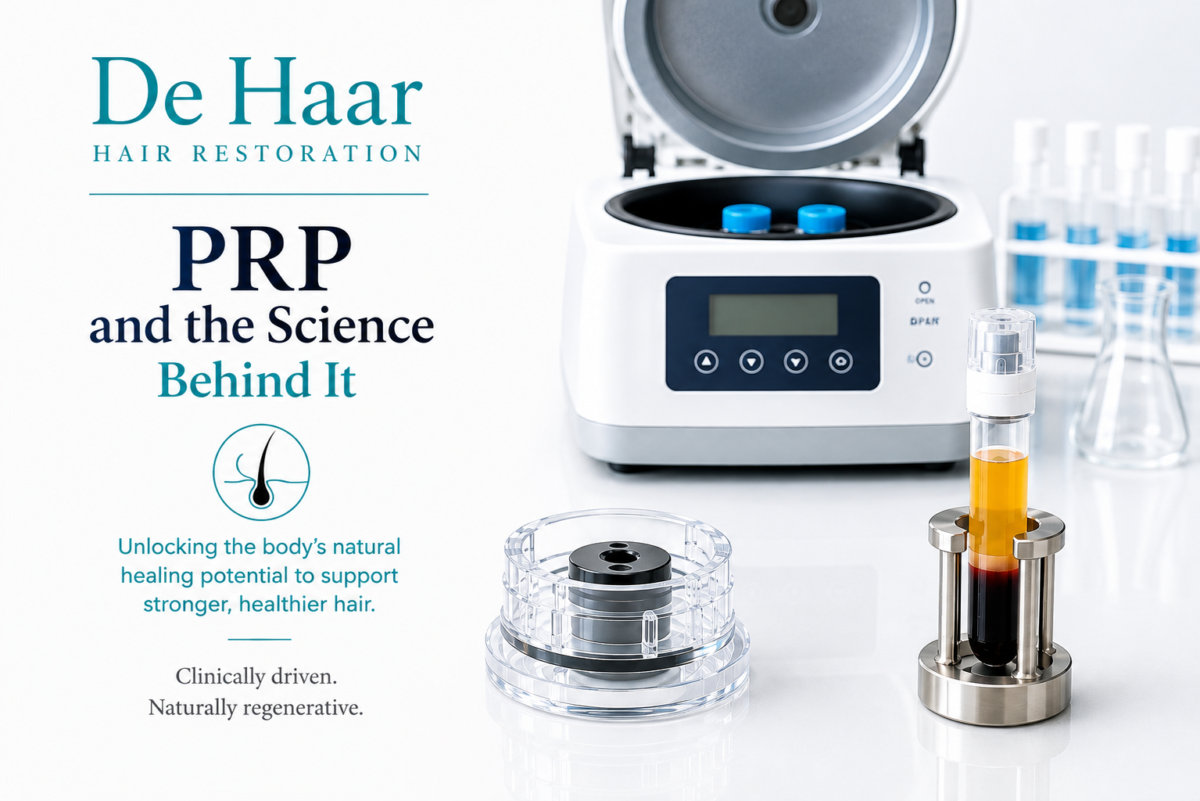
Hair thinning does not always mean that a follicle is gone. In many people with pattern hair loss, follicles remain alive but gradually become smaller and less productive. Each growth cycle may produce a finer, shorter hair until the follicle becomes nearly inactive. Platelet-rich plasma, commonly called PRP, is a nonsurgical treatment designed to support these weakened but still living follicles. It uses a concentrated portion of the patient’s own blood to deliver platelets and their signaling proteins directly to areas of thinning. Here is a closer look at the science, the growth factors involved, and the patients most likely to benefit.
What Is Platelet-Rich Plasma?
Blood contains several components, red blood cells, which carry oxygen, white blood cells, which participate in immune defense, plasma, the liquid portion of blood and among other things platelets, which help control bleeding and coordinate tissue repair. Platelets are best known for Their blood clotting potential, after an injury, but their role extends well beyond clotting. They contain small storage structures called alpha granules. When platelets become activated, these granules release growth factors, cytokines, and other signaling proteins involved in healing, blood-vessel formation, and importantly cell communication. During a PRP treatment, a small amount of the patient’s blood is drawn and placed into a centrifuge. Spinning separates the blood into layers, allowing the platelet-rich portion of the plasma to be collected. This concentrated plasma is then carefully injected into targeted areas of the scalp. Because PRP is prepared from the patient’s own blood, it is considered an autologous treatment. It does not introduce donor tissue or synthetic growth factors.
The Role of Alpha Granules in PRP
Much of PRP’s biological activity comes from specialized structures inside platelets called alpha granules. These tiny storage compartments contain a concentrated collection of growth factors and signaling proteins. When platelets become activated, the alpha granules release their contents into the surrounding tissue a process known as degranulation. Among the signaling molecules released are platelet-derived growth factor (PDGF), vascular endothelial growth factor (VEGF), transforming growth factor-beta (TGF-β), and insulin-like growth factor (IGF). Together, these signals participate in cellular communication, tissue repair, blood-vessel formation, and other processes involved in the environment surrounding the hair follicle. In PRP hair restoration, the goal is to harness this naturally occurring platelet signaling to help support viable, miniaturized follicles and a healthier environment for hair growth.
How Are Platelets Activated?
For the growth factors stored within platelet alpha granules to become available, the platelets must first be activated. Activation occurs when platelets encounter signals associated with tissue injury and the clotting process, particularly substances such as collagen and thrombin. These signals bind to receptors on the platelet surface and trigger a rapid series of internal changes, including an increase in intracellular calcium. The platelet changes shape and its alpha granules move toward and fuse with the platelet membrane, releasing their stored growth factors and signaling proteins into the surrounding tissue through degranulation. In PRP treatment, activation can therefore occur naturally after PRP is introduced into the scalp and platelets encounter tissue-derived activating signals. Some PRP preparation systems may also use an external activator before application. Once released, these signaling molecules can interact with nearby cells and participate in the biological processes involved in tissue repair, vascular signaling, and the environment surrounding the hair follicle.
Why Do Hair Follicles Become Weaker?
A healthy follicle repeatedly moves through a growth cycle, This involves. The (anagen) growth phase, the (Catagen) transitioning phase, the (telogen) or resting phase and the (exogen) phase where the hair is shed. In androgenetic alopecia, the medical term for male and female pattern hair loss genetic and hormonal signals gradually shortens the anagen phase. Susceptible follicles undergo a process called miniaturization. With each hair growth cycle the follicle becomes smaller and produces hairs that are progressively thinner, shorter, and less visible. The follicle may still be present, but it is no longer functioning at its previous capacity. This distinction is important: PRP is intended to support viable follicles. It cannot reliably recreate follicles that have been permanently destroyed or replaced by scar tissue. That is one reason early treatment offers a better opportunity for improvement rather than waiting until an area has been completely bald for many years.
How PRP Growth Factors Affect the Follicle
PRP does not work through a single ingredient or pathway. It delivers a mixture of biological signaling factors that influence the follicle’s surrounding environment, including dermal papilla cells, follicular stem-cell regions, connective tissue, and nearby blood vessels. Among the growth factors commonly associated with PRP are the following:
Platelet-Derived Growth Factor
Platelet-derived growth factor, or PDGF, participates in cell growth, cell migration, blood-vessel development, and tissue remodeling. Around the follicle, it may help create an environment that supports repair and continued cellular activity.
Vascular Endothelial Growth Factor
Vascular endothelial growth factor, or VEGF, promotes angiogenesis and the development of new blood vessels from existing vessels. Hair follicles have substantial metabolic needs during active growth. A healthy network of tiny blood vessels around the follicle helps deliver oxygen and nutrients. VEGF activity may therefore support the vascular environment required by growing follicles.
Insulin-Like Growth Factor 1
Insulin-like growth factor 1, or IGF-1, is involved in cellular growth and survival. Within the hair follicle, it is associated with the proliferation of keratinocytes which are the cells that help form the hair shaft and with maintenance of the anagen phase.
Fibroblast Growth Factors
Fibroblast growth factors, including FGF-2 and FGF-7, participate in cell proliferation and communication between different follicular structures. Research suggests that these signals may support dermal papilla activity and encourage conditions associated with active hair growth.
Epidermal Growth Factor
Epidermal growth factor, or EGF, contributes to the growth and repair of epithelial tissue. Its effects depend on concentration, timing, and the surrounding biological environment, illustrating why PRP should be understood as a coordinated mixture of signals rather than a single “miracle” growth factor.
Transforming Growth Factor Beta
Transforming growth factor beta, or TGF-β, helps regulate inflammation, tissue remodeling, and communication between cells. Its biological effects are complex and can vary depending on the specific form, concentration, and stage of the hair cycle.
Together, these and other signaling molecules may affect several processes relevant to weakened follicles.
How PRP Supports Hair Growth
Supporting follicular cell survival. Pattern hair loss is associated with progressive follicular miniaturization and changes in the survival of important cells within the follicle. Laboratory research suggests that PRP can activate pathways such as Akt and ERK and increase anti-apoptotic signaling. Apoptosis is a controlled process through which cells shut down and are removed. Reducing premature apoptosis may help dermal papilla cells remain active for longer.
Encouraging the growth phase. PRP appears to influence signals involved in moving follicles toward anagen and maintaining them in that phase. A longer, healthier anagen phase gives the follicle more time to produce a stronger hair shaft. This does not mean that every dormant follicle can be permanently restarted. Rather, PRP may help viable but underperforming follicles function more effectively.
Improving the follicle’s vascular environment. By promoting angiogenic signaling, particularly through VEGF, PRP may improve the network of small blood vessels surrounding treated follicles. This can help support the nutritional and metabolic demands of active hair production.
Stimulating communication and tissue remodeling. Hair growth depends on ongoing communication among dermal papilla cells, epithelial cells, stem-cell regions, blood vessels, and surrounding tissue. PRP’s signaling proteins may help coordinate cell proliferation, migration, and remodeling within this microenvironment.
Why PRP Can Help a Miniaturized Follicle but Not Replace a Lost One
It is helpful to think of PRP as biological support for existing follicles, not as a method of creating brand-new follicles. A miniaturized follicle may still contain the structures needed to produce hair. If treatment improves its growth signals and surrounding environment, it may begin producing a thicker or more visible strand. This can lead to improvements in hair density, shaft caliber, or shedding. If a follicle has been permanently destroyed as can occur in advanced baldness or scarring alopecia, then growth-factor signaling alone cannot rebuild it. In those situations, hair transplantation or another treatment strategy may be more appropriate. A professional hair-loss evaluation is therefore essential. The diagnosis, duration of hair loss, degree of miniaturization, scalp health, and number of remaining follicles all affect the likelihood of improvement.
Who May Benefit From PRP?
The strongest clinical evidence for PRP involves androgenetic alopecia, including male pattern hair loss and female pattern hair loss. Systematic reviews have generally found that PRP can improve hair density in some patients, although results vary because preparation methods and treatment protocols are not yet standardized. Patients with early-to-moderate thinning and visible miniaturized hair are generally more promising candidates than patients with smooth, long-standing bald areas. It is particularly helpful to many women who have diffuse hair loss and thinning throughout the scalp.
Patients seeking an additional nonsurgical option
PRP may be considered by people who cannot use certain medications, prefer a treatment made from their own blood, or want to add another modality to an existing hair-restoration plan. Depending on the diagnosis, PRP may be recommended alongside treatments such as minoxidil or prescription medication.
Hair-transplant patients
PRP may be incorporated into a hair-transplant plan to support healing and the health of existing or transplanted follicles. It should be viewed as a supportive treatment rather than a substitute for transplantation when follicular coverage is no longer adequate and follicles are no longer viable.
Selected patients with alopecia areata
Alopecia areata is an autoimmune condition and is biologically different from pattern hair loss. Studies of PRP for localized alopecia areata have reported encouraging results, but the evidence is less established and treatment must be individualized. PRP does not correct the underlying autoimmune process. Patients with alopecia areata should receive an accurate diagnosis and discuss all appropriate medical treatments with a qualified clinician.
Selected patients with chronic shedding
PRP has also been studied for chronic telogen effluvium, but evidence remains limited. Because shedding can result from iron deficiency, thyroid disease, illness, medication, hormonal changes, nutritional problems, or severe stress, the underlying trigger must be investigated and addressed.
Who May Not Be a Good Candidate?
PRP may be less suitable when The treatment area has been bald for many years, Follicles have been destroyed by significant scarring, the hair loss is being driven by an untreated medical condition, where there is active scalp infection or inflammatory disease, the patient has a serious platelet bleeding or clotting disorder and if platelet counts are very low. Medication use and medical history should always be reviewed before treatment. Patients should not stop blood thinners, anti-inflammatory medications, or any prescribed therapy without guidance from the clinician who manages those medications.
What Does the Evidence Show and is it Safe?
Research is encouraging, especially for male and female pattern hair loss. Recent systematic reviews of randomized trials have reported improvements in hair density for many PRP-treated patients. PRP outcomes are not identical from one protocol or patient to another. Current evidence supports PRP as a promising, minimally invasive treatment not as a guaranteed cure for hair loss. PRP will not revive a dead or nonviable follicle. Hair follicles work slowly, so PRP does not produce an immediate cosmetic change. When treatment is successful, an early reduction in shedding may be noticed before improvements in density or thickness become visible. Changes are generally evaluated over several months rather than days or weeks. Because pattern hair loss is progressive, we may recommend an initial treatment series followed by periodic maintenance. The number and timing of sessions should be personalized. There is no single protocol proven to be best for every patient. Because PRP comes from the your own blood, the risk of an allergic reaction to the injected material is low. Temporary tenderness, pinpoint bleeding, swelling, bruising, headache, or scalp sensitivity can occur. Infection is uncommon but possible with any injection procedure. Careful preparation, sterile technique, appropriate patient screening, and proper injection placement all matter.
The Most Important Step Is an Accurate Diagnosis
PRP is most useful when it is matched to the right diagnosis and realistic treatment goal. Hair thinning can result from pattern hair loss, autoimmune disease, inflammation, scarring, hormonal changes, nutritional deficiency, medications, illness, or several causes at once. PRP can provide valuable biological support to follicles that are weakened but still capable of producing hair.
