Mini Corrective Transplant Procedures
A Small Procedure Can Make a Meaningful Difference
Not every hair restoration procedure needs to involve thousands of grafts or a major change in appearance. Sometimes, the concern is surprisingly small: a slightly uneven hairline, a receding corner, a small scar where hair no longer grows, or an area from a previous transplant that could benefit from additional refinement. In these situations a small procedure hair transplant can offer a highly targeted solution. Rather than restoring a large area of hair loss, these smaller procedures use a limited number of carefully selected follicular units to address a specific concern. The goal is not necessarily transformation. Often, it is simply to correct, soften, fill or refine a problem area so naturally that the improvement does not look like a hair transplant at all.
The same principles used in larger hair restoration procedures still apply to these smaller procedures. Healthy follicles are obtained from an appropriate donor area and transplanted into carefully planned recipient sites.
What changes is the scale
Instead of treating extensive thinning or baldness, the surgeon concentrates on a relatively small area where a modest number of grafts may produce a noticeable improvement.
Depending upon the individual, grafts may be obtained using FUE (Follicular Unit Excision) or, in selected circumstances, another appropriate harvesting method. The choice should be based on the patient’s donor hair, the number of grafts required, previous procedures, hairstyle and long-term hair restoration plan.
Small Areas That May Benefit From Hair Transplantation
Mini procedures can be useful for a number of very specific concerns.
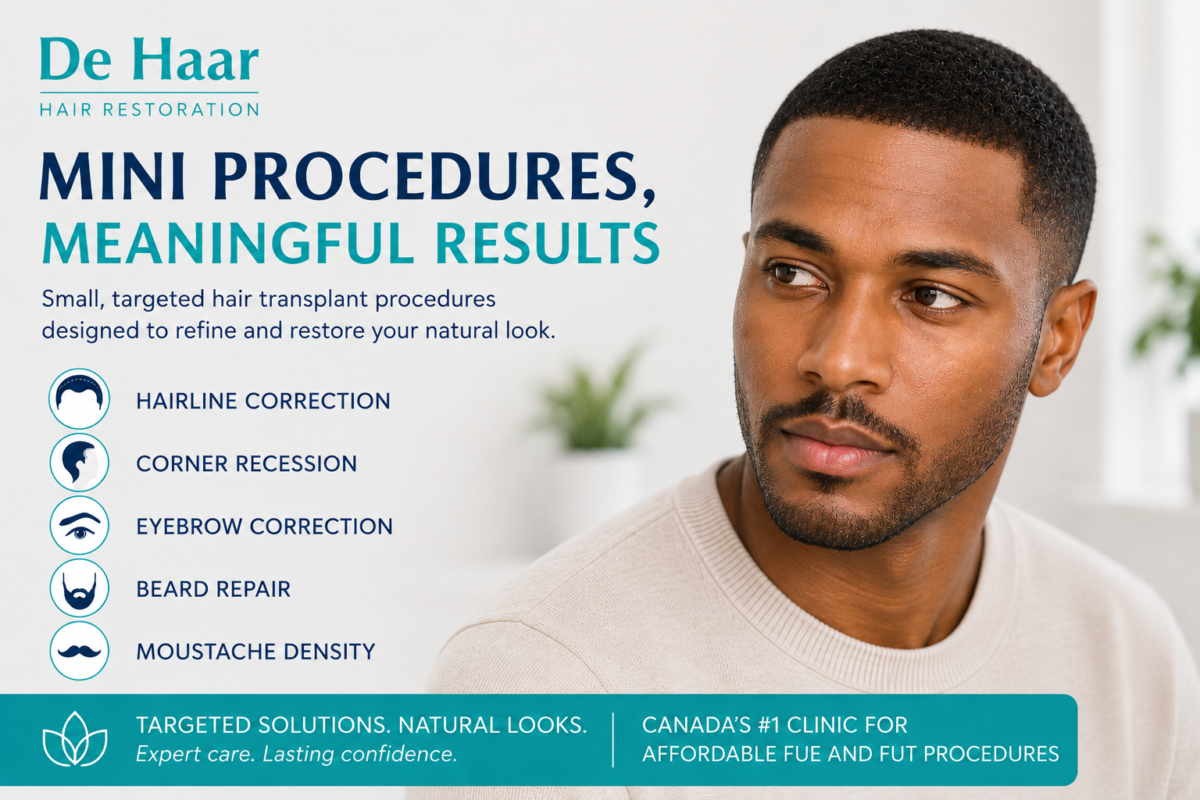
Hairline Correction
The hairline is one of the most visually important areas of hair restoration. A person may have a generally good head of hair but dislike a small area of recession, asymmetry or irregularity along the frontal hairline. In appropriate candidates, strategically placed follicular units can soften or refine these areas without substantially changing the rest of the hairline.
Temple Points and Corners
Mini transplants are an ideal way to fill recessions, temple points, corners and bald spots. Early recession does not always occur evenly. One corner may recede far more than the other or limited temporal recession may create an appearance that bothers the patient even though significant hair loss has not occurred elsewhere. A small transplant may sometimes be used to restore balance or soften these areas.
Eyebrows, Beards and Moustache Corrections
Small procedures are ideal for fixing density issues with beards and moustaches giving you a full robust look. Eyebrows can be reshaped, filled in and custom designed to suite your features perfectly.
Transplanting Hair Into Scars
Hair transplantation can sometimes be used to camouflage selected scars where follicles have been permanently lost. These might include scars resulting from previous surgery, trauma or certain stable medical conditions. Scar tissue, however, is different from normal scalp tissue. Blood supply, thickness and tissue characteristics can affect graft survival. For this reason, transplantation into scars requires careful evaluation and realistic expectations. Not every scar is suitable for transplantation.
Small Procedures Still Require Great Precision
It is easy to assume that a smaller transplant is automatically a simpler transplant. That isn’t necessarily the case. When only a small area is being changed, subtle details become extremely important.
The surgeon must consider:
- the natural direction and angle of surrounding hairs
- follicular-unit size
- hair calibre and texture
- density
- existing hairline architecture
- facial proportions
- future hair loss
This is particularly important at the frontal hairline, where even a small number of incorrectly positioned grafts can be noticeable. Natural hairlines are not perfectly straight or uniformly dense. They contain subtle irregularities and variations in density, direction and follicular-unit composition. Reproducing those characteristics is one of the most important aspects of creating a result that blends naturally with the patient’s existing hair.
The Importance of Planning for Future Hair Loss
A mini transplant should never be planned in isolation. A patient may only want to repair a small receding area today, but hereditary hair loss may continue behind or around the transplanted follicles. Because transplanted follicles may remain while surrounding non-transplanted hair continues to thin, the surgeon must consider the patient’s likely pattern of future hair loss before deciding whether surgery is appropriate. For some patients, treatment designed to help preserve existing hair may also be discussed. The objective should be a result that makes sense not only immediately after the procedure, but years into the future.
Is Recovery Easier With a Smaller Procedure?
Yes. Because fewer grafts and a smaller recipient area are generally involved, patients generally find recovery from a limited procedure relatively manageable. However, it is still hair transplant surgery. The transplanted follicles still require appropriate postoperative care, and temporary redness, crusting or shedding will occur. The transplanted hairs commonly shed out of the follicle, before new growth begins, and final maturation still takes time. A smaller procedure does not make the biology of hair growth faster.
Who Might Be a Good Candidate?
A mini transplant may be worth discussing if you have a small, clearly defined area that concerns you, good donor hair and realistic expectations about what transplantation can accomplish.
Sometimes Less Really Is More
Hair restoration does not always have to be about dramatic change. For some patients, the most successful procedure may involve relatively few grafts placed with exceptional care. A subtle adjustment to the hairline, correction of an asymmetry or restoration of a small area can have a surprisingly meaningful effect while preserving the person’s existing appearance. If there is one particular area of your hairline, scalp or brows that has been bothering you, you do not necessarily need an extensive hair transplant to explore your options.
At De Haar Hair Restorations we have affordable options to fix areas of concern you so you can go about your day with confidence. Talk to us today.
